
Photography Guides
Night Photography Guide: Camera Settings, Long Exposure & Star Tips
Daydream Editorial
· 12 min read
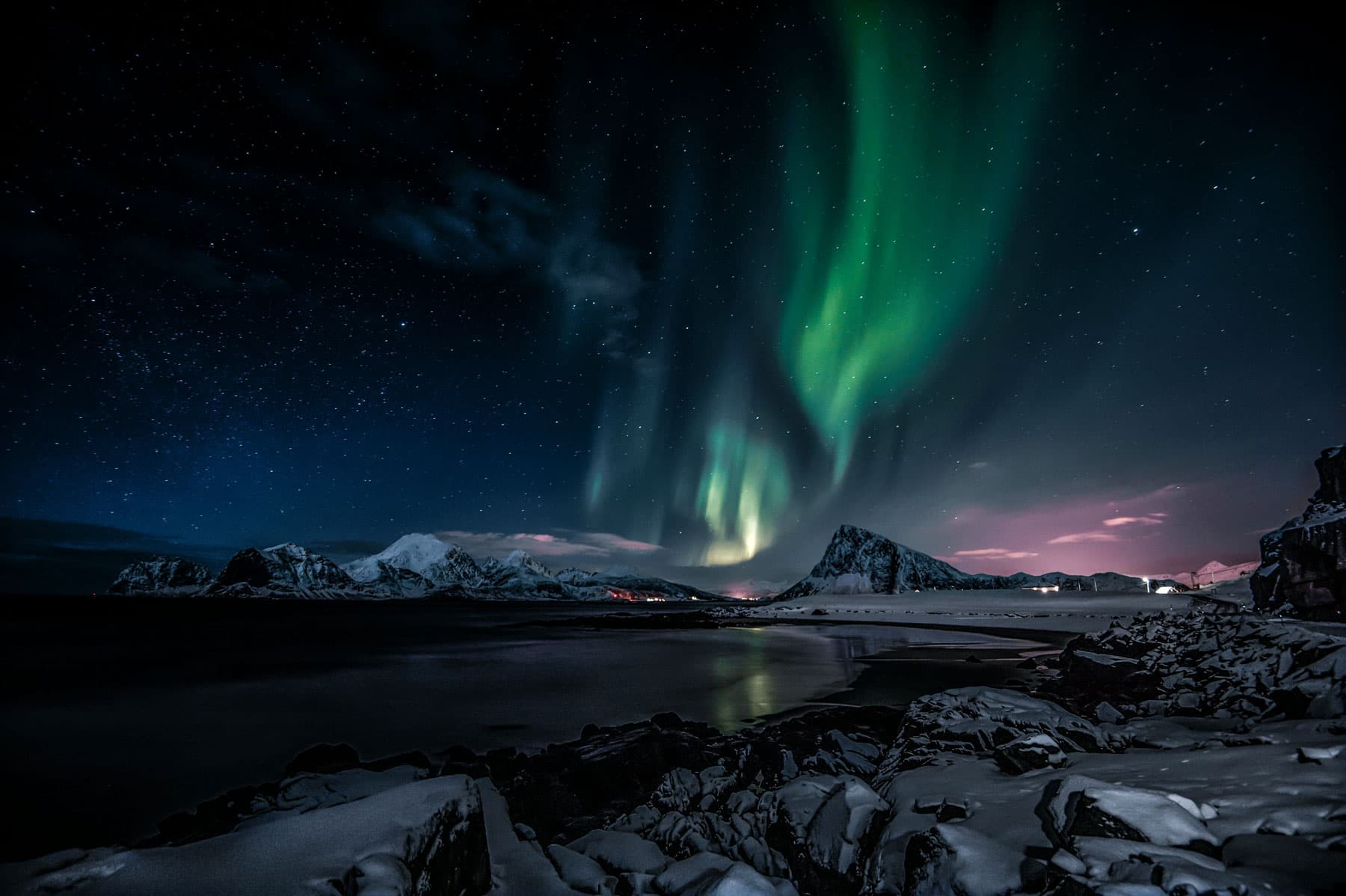
Night photography on film reveals a harsh reality: your light meter becomes nearly useless in darkness, and film behaves unpredictably during long exposures. Load ISO 100 film and watch your 30-second exposures come back completely black. Film photography at night demands understanding reciprocity failure, push processing, and working blind. You're trusting calculations and experience, waiting weeks to see if you nailed the exposure.
What You'll Learn
This comprehensive guide covers everything you need to master night photography on film—from essential gear and camera settings to long exposure techniques, star photography tips, and working with city lights. Whether you're shooting the Milky Way, urban landscapes, or light trails, you'll find actionable advice to capture nightscapes with authentic film aesthetics.
Who This Guide Is For
Photographers (intermediate to advanced) who want to capture stars, cityscapes, and nighttime scenes on film, understanding the unique challenges of long exposures and reciprocity failure without digital safety nets.
The challenge and reward of night photography
Night photography demands technical precision and patience. You're working in darkness, calculating exposures that extend into minutes, and compensating for reciprocity failure. On film, you can't check results until weeks later.
When you nail it, you capture scenes with atmosphere that make viewers feel the stillness of night. Film's organic grain adds texture to star fields. The difference comes down to understanding film's behavior in long exposures and trusting calculations.
Essential equipment for night photography
Certain tools are non-negotiable for night photography on film.
Camera body requirements
Manual SLRs with bulb mode and cable release sockets handle night work well. A Nikon FE2 offers dependable metering and bulb mode. The Pentax 67 delivers exceptional detail for medium format. The Contax T2 provides sharp optics for urban work. Budget option: any manual SLR with bulb mode works.
Lenses that work
Wide-angle lenses (24mm to 35mm) capture expansive night skies. A 28mm f/2.8 offers versatility. Faster apertures (f/1.4-f/2) gather more light but cost more. For star photography, f/2.8 provides sufficient light gathering.
Standard focal lengths (50mm f/1.8) work for urban night photography.
Film stocks & accessories
Portra 800 delivers exceptional performance with minimal reciprocity failure. Cinestill 400D handles tungsten city lights with unique halation glow. Black and white film like Tri-X 400 emphasizes contrast. Kodak Gold 200 offers affordability.
Essential accessories: sturdy tripod (required), cable release, external light meter, flashlight with red mode, spare batteries.
Camera settings for night photography
Start with these settings, then adapt based on conditions.
Exposure & metering
Meter the brightest area you want detail in. Your light meter struggles in darkness. Spot metering on illuminated buildings gives baseline readings.
Settings recipe for city night scenes:
- Film: Cinestill 400D (ISO 400)
- Aperture: f/2.8 or f/4
- Shutter speed: 4-30 seconds (bulb mode)
- Metering: Spot meter on brightest lights
Settings recipe for star photography:
- Film: Portra 800 pushed to 1600
- Aperture: f/2.8
- Shutter speed: 20-30 seconds (500 Rule)
At $18 per roll, bracket exposures: calculated exposure, +1 stop, +2 stops.
- •Film: Cinestill 400D (ISO 400)
- •Aperture: f/2.8 or f/4
- •Shutter speed: 4-30 seconds (bulb mode)
- •Metering: Spot meter on brightest lights
- •Film: Portra 800 pushed to 1600
- •Aperture: f/2.8
- •Shutter speed: 20-30 seconds (500 Rule)
Understanding reciprocity failure
Film loses sensitivity over time in long exposures. A calculated 30-second exposure might need 45-60 seconds to achieve proper density.
Portra 800: minimal failure up to 1 minute. Cinestill 400D: minimal failure up to 30 seconds. Ektar 100: add 1 stop at 10 seconds, 2 stops at 100 seconds. Consult manufacturer data sheets.
Focus technique
Point your camera at a bright star or distant light. Use your viewfinder's split-prism or set lens to infinity mark.
For star photography, set focus to infinity and tape it there. For urban scenes, focus on illuminated buildings. With practice, you'll trust infinity focus.
Composition & creative techniques
Technical settings get you exposed images. Composition captures the magic of night.
Framing & perspective
Shoot from low angles to emphasize foreground against star fields. Include landscape features for scale. Rule of thirds: place horizon on lower third, let sky dominate upper two-thirds.
For urban night photography, include light sources as compositional elements. Streetlights and neon signs create visual anchors.
Leading lines & shapes
Look for lines created by roads or architectural elements. Light trails from cars create dynamic leading lines. Use 30-second to 2-minute exposures to capture vehicle movement as streaks.
Water reflects city lights and creates symmetry. Wet pavement after rain amplifies light and adds the blue hour aesthetic.
Capturing stars & celestial subjects
Star photography requires the 500 Rule: divide 500 by your focal length. For 24mm lens: 20 seconds maximum. For 50mm: 10 seconds maximum.
Include foreground interest. Trees or structures silhouetted against sky create compelling compositions. Use a flashlight to subtly illuminate foreground during exposure.
Genre-specific composition tips
For Milky Way photography, shoot when the galactic core is visible. Position it diagonally for dynamic composition. For urban work, embrace light trails and neon reflections. For moon photography, include landscape context.
Lighting techniques for night photography
Light makes or breaks night photos. Film's response to low light creates unique challenges.
Natural light strategies
Moonlight provides surprising illumination. A full moon can light landscapes enough to shoot at f/4, 2-4 minutes, ISO 400. Quarter moon provides subtler illumination.
Blue hour (20-40 minutes after sunset) offers residual sky glow that balances with city lights. This creates the blue hour aesthetic where lights glow warmly against deep blue skies. Shoot Cinestill 400D during blue hour for dramatic halation.
Starlight alone requires fast film. Portra 800 pushed to 1600 captures star fields. Expect 20-30 second exposures at f/2.8.
Artificial light approach
City lights provide abundant illumination. Streetlights and neon signs create the retro vibe associated with urban night scenes. Tungsten lights render warm on daylight film. Cinestill 400D is tungsten-balanced, rendering city lights neutrally.
Use ambient light creatively. Side light from streetlights reveals texture. Backlit subjects create silhouettes.
Challenging lighting scenarios
Extreme contrast between bright lights and dark sky exceeds film's latitude. Expose for the lights and accept dark shadows. Bracketing is essential.
Light trails require 15-second to 2-minute exposures. At f/8, ISO 100, a 30-second exposure captures smooth trails while maintaining detail.
Night photography workflow & shooting tips
A systematic approach maximizes success and reduces wasted film.
Preparation & planning
Scout locations during daylight. Check weather forecasts for clear skies. Research moon phases (new moon for stars, full moon for landscape illumination).
Checklist: appropriate film loaded, spare rolls, tripod, cable release, flashlight, warm layers, notebook for exposure calculations, reciprocity data.
Arrive before sunset to set up while you can still see. Compose and focus in twilight.
During the shoot
Start with test exposures. Bracket heavily because you can't check results. For star photography, shoot at calculated exposure, +1 stop, +2 stops. For urban scenes, bracket shutter speeds: 15s, 30s, 60s.
Work methodically. Compose, focus, calculate exposure, set camera, use cable release, wait. Sessions typically last 2-4 hours. Bring warm clothing.
Adapting to challenges
When clouds roll in, wait or relocate. When wind shakes your tripod, weight it with your camera bag. When condensation forms, use a lens cloth. When you run low on film, prioritize proven compositions.
Post-processing night photography
Night photos benefit from careful scanning and minimal editing.
Essential adjustments
Communicate with your lab about long exposure reciprocity. Request scans that preserve highlight detail without crushing blacks.
Workflow: adjust levels for tonal range, subtle S-curve for depth, correct color shifts from reciprocity failure, sharpen stars slightly.
Embrace film's grain—it adds organic texture that complements night scenes.
Consistency & style
Develop all film from a shoot with the same lab. Batch process basic adjustments. Individual tweaks handle specific variations.
Common mistakes & how to avoid them
Even experienced photographers make these mistakes.
Mistake 1: Ignoring reciprocity failure
Calculating exposure without compensating creates underexposed images. Instead, consult manufacturer data sheets and add 1-2 stops for exposures beyond 1 second.
Mistake 2: Wrong film choice
Loading slow film (ISO 100-200) for star photography guarantees failure. Instead, choose fast film (800-1600) appropriate for available light.
Mistake 3: Insufficient stability
Touching the camera during exposure creates blur. Instead, use a cable release and mirror lock-up. Wait 2-3 seconds after mirror-up.
Mistake 4: Poor focus technique
Relying on autofocus in darkness creates soft images. Instead, manually focus on bright stars. Set to infinity and tape focus ring.
Mistake 5: Not bracketing exposures
Shooting single exposures wastes opportunities. Instead, bracket heavily: calculated exposure, +1 stop, +2 stops.
Pro night photography tips & techniques
Once you've mastered the basics, these advanced techniques elevate your night photography.
Use the 500 Rule: Divide 500 by your focal length to find maximum shutter speed before stars trail. This prevents motion blur from Earth's rotation.
Light paint foregrounds: Use a flashlight during long exposures to subtly illuminate foreground elements. Red light preserves night vision while adding detail.
Embrace reciprocity color shifts: Long exposures create color shifts (often cyan or magenta) that add to the vintage photo aesthetic. Don't fight these shifts.
Shoot during blue hour: The 20-40 minutes after sunset provide residual sky glow that balances with city lights, creating dramatic urban scenes with the blue hour aesthetic.
Gear recommendations summary
* Prices as of December 2024 – always check current pricing. These are starting points, not requirements.
| Category | Budget Option | Mid-Range | Professional |
|---|---|---|---|
| Camera Body | Any manual SLR with bulb ($50-150) | Nikon FE2 ($300-500) | Pentax 67 ($800-1500) |
| Primary Lens | 28mm f/2.8 ($150-300) | 24mm f/2.8 ($300-600) | 24mm f/1.4 ($800-1500) |
| Film Stock | Kodak Gold 200 ($8-10/roll) | Portra 800 ($15-18/roll) | Cinestill 400D ($16-20/roll) |
| Key Accessory | Basic tripod ($30-50) | Manfrotto tripod ($150-300) | Gitzo carbon fiber ($400-800) |
FAQs (intent catchers)
What are the best camera settings for night photography?
For night photography on film, use manual mode with bulb setting, f/2.8-f/4 aperture (widest practical), 20-30 seconds for stars (500 Rule), 4-30 seconds for cityscapes, and ISO 400-800 film (pushed to 1600 if needed). Compensate for reciprocity failure by adding 1-2 stops for exposures beyond 1 second. Shoot Portra 800 or Cinestill 400D for best results. Use a tripod and cable release for all night photography.
What camera is best for night photography?
The best camera for night photography has bulb mode, cable release capability, and reliable metering. The Nikon FE2 excels with dependable metering and sturdy build, while the Pentax 67 offers exceptional detail for medium format. For beginners, any manual SLR with bulb mode works if paired with an external light meter. Honestly, a sturdy tripod and proper technique matter more than expensive camera bodies.
How do I photograph stars on film?
Star photography on film requires fast film, wide apertures, and understanding the 500 Rule. Load Portra 800 pushed to 1600, shoot at f/2.8, and calculate maximum shutter speed (500 ÷ focal length). For 24mm lens: 20 seconds maximum before stars trail. Compensate for reciprocity failure by adding 1 stop. Focus manually on a bright star. Use a cable release and sturdy tripod. Bracket exposures because you can't check results.
What lens should I use for night photography?
For night photography, 24mm to 35mm wide-angle lenses work best because they capture expansive night skies and cityscapes. A 28mm f/2.8 offers excellent versatility. Faster apertures (f/1.4-f/2) gather more light but cost significantly more. For star photography, f/2.8 provides sufficient light gathering. Budget option: any wide-angle lens f/2.8 or faster delivers good results. Aperture matters more than focal length for night work.
How do I avoid star trails?
Avoid star trails by using the 500 Rule: divide 500 by your focal length to find maximum shutter speed. For 24mm lens: 500÷24 = 20 seconds. For 50mm: 500÷50 = 10 seconds. Beyond these times, Earth's rotation creates visible star movement. Use wider lenses for longer exposures. Focus manually on infinity. Use a cable release to eliminate vibration. If you want star trails intentionally, expose for several minutes to hours.
What are common night photography mistakes?
The most common night photography mistakes are: ignoring reciprocity failure (add 1-2 stops for long exposures), choosing wrong film speed (use ISO 400-800 minimum), insufficient stability (use sturdy tripod and cable release), poor focus technique (manually focus on bright stars or lights), and not bracketing exposures (bracket heavily because you can't check results). Ignoring reciprocity failure is most detrimental—it creates consistently underexposed images.
What film stock is best for night photography?
For night photography, Portra 800 offers the best balance of fine grain, minimal reciprocity failure, and pushability to 1600 or 3200. Cinestill 400D handles tungsten city lights beautifully with unique halation glow around light sources. For long star exposures, Portra 800 has better reciprocity characteristics than Ektar 100. For black and white urban work, Tri-X 400 or HP5 Plus emphasize contrast and texture. Start with Portra 800 for versatile night performance.
How long should I expose for night photography?
Exposure length depends on your subject and available light. For star photography, use 15-30 seconds maximum (500 Rule) before stars trail. For cityscapes with ambient light, 4-30 seconds at f/2.8-f/4, ISO 400 works well. For light trails, 30 seconds to 2 minutes captures vehicle movement. For star trails, expose for several minutes to hours. Always compensate for reciprocity failure by adding 1-2 stops for exposures beyond 1 second. Bracket exposures because film latitude is limited at night.
Conclusion: Your night photography journey
Night photography demands technical precision, careful planning, and patience, but the results capture scenes with atmosphere that makes viewers feel the stillness and magic of darkness. Start with a sturdy tripod and fast film—these fundamentals matter more than expensive gear. Practice builds exposure calculation skills and compositional eye faster than overthinking every shot.
Remember: even professional night photographers underexpose from reciprocity failure and waste frames on miscalculations. Every experienced photographer struggled with long exposures and focus in darkness when starting. The difference is persistence and learning from each roll.
Next steps:
- Load Portra 800 and shoot urban night scenes to practice metering and reciprocity
- Study the 500 Rule and practice star photography on a clear night
- Research reciprocity failure data for your chosen film stocks
Your unique perspective on night photography matters because darkness reveals scenes invisible during day. Now get out there and capture the magic of night.
- •Load Portra 800 and shoot urban night scenes to practice metering and reciprocity
- •Study the 500 Rule and practice star photography on a clear night
- •Research reciprocity failure data for your chosen film stocks
Author notes (E-E-A-T)
Written by: Daydream Content Team — photographers with 15+ years of combined experience shooting night photography, astrophotography, and urban nightscapes on film and digital.
Experience: Hundreds of night shoots from star photography in remote locations to urban light trails in major cities. Extensive work with long exposures and reciprocity failure compensation across multiple film stocks.
Gear used: Nikon FE2, Pentax 67, Contax T2, various wide-angle lenses. Primary film stocks: Portra 800, Cinestill 400D, Tri-X 400, all with reciprocity compensation.
Teaching background: Workshops on night photography technique, long exposure calculations, and reciprocity failure for photographers transitioning from digital to film.
Conflicts of interest: Daydream is our film emulation app. We believe in authentic film photography and created Daydream to make film aesthetics more accessible.
Related Topics
Related reading
Join the iOS Beta
Join the beta to experience authentic film photography with Daydream Film when we launch.