
Camera Reviews
Ricoh GR1v Review: The Street Shooter's Secret Weapon
Daydream Editorial
· 8 min read
Verdict
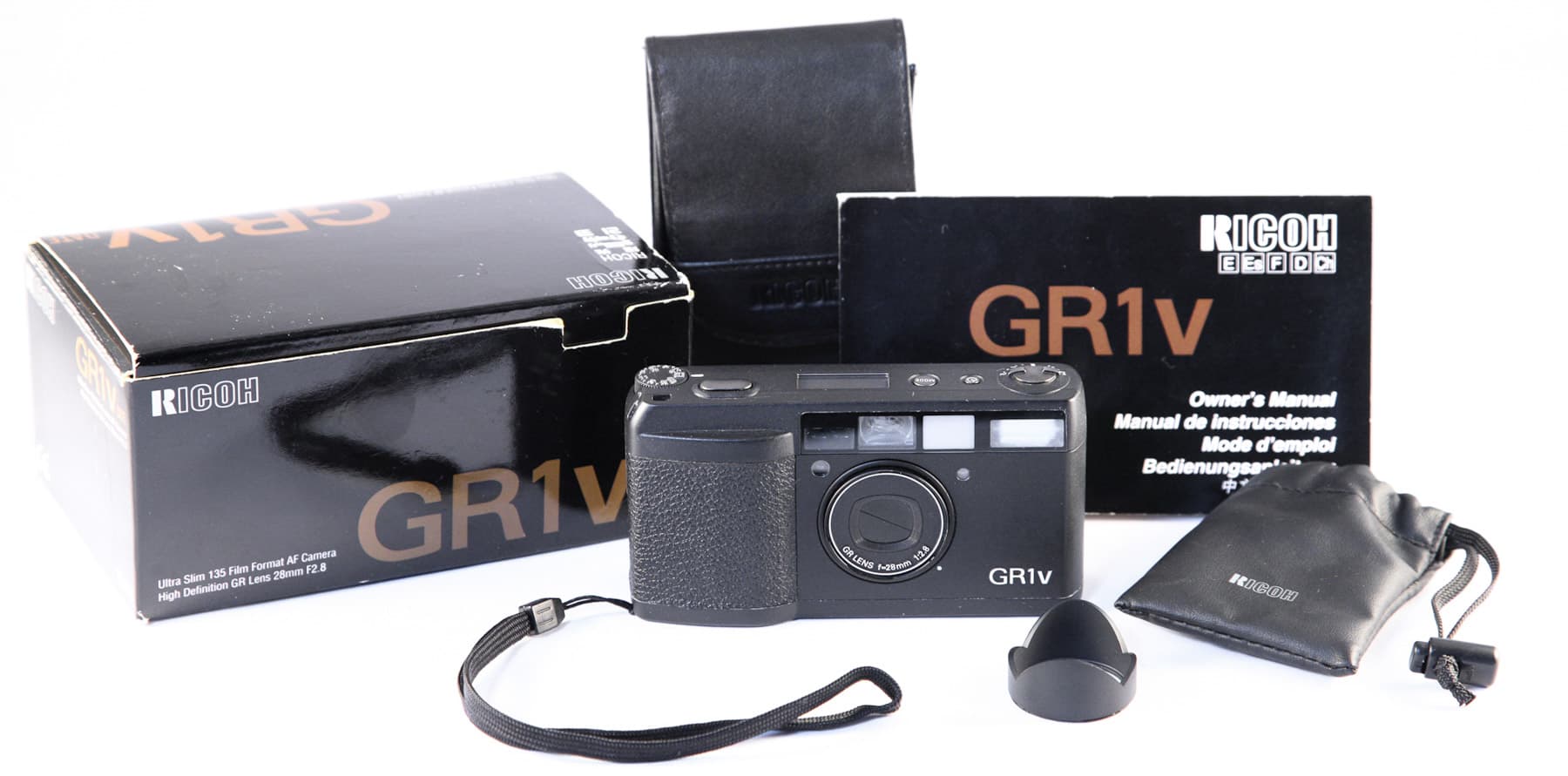
The GR1v is a magnesium-bodied compact with an exceptional 28mm f/2.8 lens, phase-detection autofocus, aperture priority, manual ISO override, and snap focus modes. It's genuinely pocketable at 26.5mm thin and delivers razor-sharp images. For street and travel photography, nothing else offers this combination of control, speed, and portability.
Street photographers call the Ricoh GR1v one of the best compact cameras ever made, praising its legendary 28mm f/2.8 lens, snap focus modes, and genuinely pocketable size at 26.5mm thin. But the GR1v carries the same fatal flaw as all GR models: thin ribbon cables that will eventually fail, with no repair options.
Background & Key Features
Ricoh released the GR1v in 2001 as the final evolution of the GR1 series (1996-2001). It succeeded the GR1 and GR1s, adding manual ISO override, auto-bracketing, and expanded snap focus distances that made it the most capable GR model ever produced.
The magnesium-alloy body houses a Ricoh GR 28mm f/2.8 lens (7 elements in 4 groups) with multicoating and aspherical elements that deliver exceptional sharpness. Notable features include 3-point phase-detection autofocus, aperture priority (f/2.8 to f/22 in half-stops), programmed autoexposure, electronic shutter (2s to 1/500s), exposure compensation (+2 to -2 EV in half-stops), manual focus modes (1m, 2m, 3m, 5m, infinity), snap focus, built-in flash, and DX film speed reading with manual ISO override. That manual ISO override is the killer feature, letting you shoot pushed or pulled film without DX hacks.
At 117×61×26.5mm and 177g, it's smaller and lighter than most premium compacts. The camera pre-winds film, protecting exposed frames if the back accidentally opens.
Design & Handling
The magnesium body feels dense and solid at 177g, with a perfectly proportioned grip that makes one-handed shooting natural. The camera is astonishingly thin at 26.5mm, disappearing into any pocket without creating a bulge. You'll forget you're carrying it until you need it. The smooth finish lacks texture, making a wrist strap essential to avoid dropping it. The sliding lens cover doubles as the power switch, which is elegant.
The viewfinder is small but clear, with LCD framelines, parallax correction marks, shutter speed indicator, and focus distance symbols. An LED illuminates the display in low light, which is thoughtful. The top LCD shows frame count, aperture, ISO, and shooting mode in clear digits.
The leaf shutter is whisper-quiet, a gentle click that won't disturb candid subjects on the street. The focusing and film advance are louder than the shutter, which is ironic but not problematic. The camera pre-winds the entire roll out of the canister in 30 seconds, then rewinds each frame as you shoot. This protects exposed images if the back accidentally opens and shows remaining frames instead of cumulative count, which is more intuitive.
How the Ricoh GR1v Shoots: Street Photography and Travel Photography Performance
Metering & exposure behavior
The center-weighted metering is consistently accurate, nailing exposure in 90%+ of situations without fuss. The 2s to 1/500s shutter range handles everything from handheld low-light to bright sun. In high-contrast scenes, the meter preserves highlights, which works beautifully with negative film's latitude. The exposure compensation dial clicks through half-stop increments from +2 to -2 EV and retains settings when powered off, which is smarter than cameras that reset. For night photography, the 2-second minimum shutter allows handheld work with steady hands and fast film, opening up possibilities that faster minimum shutters can't touch.
Focusing experience
The 3-point phase-detection autofocus is fast and reliable, locking focus in 85-90% of shots without hesitation. The system uses both passive and active infrared, which gives it versatility in different lighting conditions. Half-pressing locks focus and exposure. The 0.35m minimum focus distance is exceptional for a compact, allowing close-up work that most point-and-shoots can't handle. For street photography, the AF is quick with minimal shutter lag, so you won't miss fleeting moments.
Manual focus modes include snap focus (preset to 2m), fixed distances (1m, 2m, 3m, 5m, infinity), single-point AF, multi-point AF, and infinity lock. Snap mode is brilliant for zone focusing: set 2m at f/8 and shoot without waiting for AF, which eliminates shutter lag entirely. Changing manual distances requires a long press of the Mode button, which takes some getting used to but becomes second nature.
Lens character & image quality
The Ricoh GR 28mm f/2.8 is one of the best lenses ever packed into a compact, period. The center sharpness is exceptional. Wide open at f/2.8, the lens shows slightly lower contrast with a hint of haze, but resolves fine details beautifully. This softer rendering is actually an asset, giving images a more classical look that's less clinical than modern lenses.
Stop down to f/5.6 and the lens transforms completely: razor-sharp corner to corner with stunning detail that rivals interchangeable lenses. The sweet spot is f/5.6 to f/11, where the lens delivers flawless images that make you forget you're shooting a compact.
Color rendition is excellent with rich saturation. On Portra 400, skin tones are beautiful and natural. On Ektar 100, colors are vibrant without being oversaturated. Black and white film reveals stunning tonal separation, with Tri-X showing deep blacks that make street photography sing. The moderate contrast preserves detail in highlights and shadows, which is perfect for high-contrast urban scenes.
Bokeh at f/2.8 is smooth and pleasant, not creamy but inoffensive. The 0.35m close focus combined with f/2.8 creates more background separation than you'd expect from a wide-angle compact. Flare resistance is excellent. Vignetting is barely noticeable, even wide open.
Film pairings that sing
- Portra 400 for versatile shooting with beautiful skin tones
- Kodak Gold 200 for warm tones and affordable everyday shooting
- Ektar 100 for maximum sharpness and vibrant color
- Tri-X 400 for classic black and white with rich contrast
Best Uses: Urban Photography, Night Photography, and More
Best at: Street photography (fast AF, quiet, snap focus), travel photography (compact, excellent lens), urban photography (28mm for cityscapes), night photography (2s shutter, f/2.8), documentary work (unobtrusive, professional controls)
Struggles with: Portraits at minimum focus (28mm distorts), subjects beyond 10m in dim light (AF hunts), bright daylight at f/2.8 (1/500s max shutter), action photography
If this is you → pick this body:
- "I want the best 28mm compact with full control" → Ricoh GR1v
- "I prefer 35mm focal length" → Contax T2
- "I want 28mm but don't need manual controls" → Ricoh GR1 or GR1s
Ricoh GR1v vs Contax T2, Olympus Mju II, and Konica Hexar AF
The Contax T2 offers titanium build and 38mm Zeiss Sonnar for $800-1,200 versus the GR1v's $400-600. The T2 is larger and lacks manual ISO override. The Mju II delivers f/2.8 with weatherproofing for $250-350, but no manual controls or aperture priority. The Konica Hexar AF provides f/2 with aperture priority for $600-800, but it's significantly larger and won't fit in most pockets.
Choose the GR1v for the best 28mm compact with extensive controls in a truly pocketable package. Choose the T2 for premium build and 35mm-equivalent focal length if you can afford double the price. Choose the Mju II for simpler operation at half price if you don't need manual controls. Choose the Hexar AF for a faster f/2 lens if you're willing to sacrifice pocketability. The GR1v's 28mm, extensive controls, and true pocketability are unmatched in the compact camera world.
* Prices as of December 2025. GR1v prices reflect cult status among street photographers.
| Camera | Why choose it | Where it loses vs Ricoh GR1v | Typical used price* |
|---|---|---|---|
| Ricoh GR1 or GR1s | Nearly identical lens, $200-300 less | No manual ISO, fewer snap focus options | $200-350 |
| Contax T2 | Premium titanium, 38mm Zeiss Sonnar, aperture priority | Larger, heavier, double the price, 38mm not 28mm | $800-1,200 |
| Olympus Mju II | Sharp 35mm f/2.8, weatherproof, half the price | No manual controls, 35mm not 28mm | $250-350 |
Is the Ricoh GR1v Worth It in 2025?
As of December 2025, the GR1v sells for $400-600. This reflects its cult status and being the last, most advanced model. The GR1v is worth it for photographers who need manual ISO override, auto-bracketing, and expanded snap focus modes. If you don't need these features, the GR1 or GR1s ($200-350) offer nearly identical image quality.
Worth it for street photographers who value 28mm, extensive controls, and true pocketability. Not worth it if you prefer 35mm (get a T2 or Mju II), don't need manual controls (get a GR1/GR1s), or want the cheapest option (Mju II for $250-350). The main risk is LCD bleed and motor failure. Ricoh no longer repairs these cameras. The GR1v justifies its price through unmatched control and pocketability, but earlier GR1/GR1s models offer 90% of the experience for 50% of the cost.
The Bottom Line
Buy it if
- You're a street photographer who needs 28mm, values manual controls (ISO override, aperture priority, snap focus), and wants true pocketability. You understand LCD/motor risks.
Skip it if
- You prefer 35mm (get T2 or Mju II), don't need manual controls (get GR1/GR1s for less), or want the safest investment (LCD/motor issues common). Get a Mju II for half price.
Consider it if
You shoot street/travel regularly and want the most capable 28mm compact ever made. $400-600.
Frequently Asked Questions
Is the Ricoh GR1v worth it in December 2025?
In December 2025, the Ricoh GR1v sells for $400-600. It's worth it for street photographers who need 28mm focal length, manual controls (ISO override, aperture priority, snap focus), and true pocketability. The GR1v offers unmatched control in a genuinely pocketable package. If you don't need manual ISO override or expanded snap focus modes, the GR1 or GR1s ($200-350) offer nearly identical image quality. The main risk is LCD bleed and motor failure, which are common issues. Ricoh no longer repairs these cameras. Worth it for serious street shooters; skip it if you prefer 35mm focal length or don't need manual controls.
Ricoh GR1v vs Contax T2 – which is better?
The Ricoh GR1v has a 28mm f/2.8 lens, magnesium body, extensive manual controls, and costs $400-600. The Contax T2 has a 38mm f/2.8 Zeiss Sonnar lens, titanium body, aperture priority, and costs $800-1,200. The GR1v is smaller (26.5mm thin vs T2's bulkier body), lighter (177g vs 295g), and offers more control options (snap focus, manual ISO override). Choose the GR1v for 28mm focal length, true pocketability, and better value. Choose the T2 for 38mm focal length, premium titanium build, and Zeiss rendering (but pay double and carry more weight). For street photography, the GR1v's 28mm and snap focus modes give it the edge.
What are common problems with the Ricoh GR1v?
Common issues include LCD bleed (top LCD fades and stops displaying information), motor failure (film advance mechanism stops working), foam degradation inside film compartment, and power button failure. The LCD bleed is so common that many blogs document DIY fixes. Before buying, test all functions with a battery, verify the LCD displays clearly, check that the motor winds and rewinds smoothly, and buy from sellers offering returns. Ricoh no longer repairs the GR1v, making professional repair difficult and expensive. A broken GR1v is worth $200+; a working one is worth $400-600. Factor in potential repair costs when buying.
Which film should I start with on the Ricoh GR1v?
Start with Portra 400 for its forgiving latitude, beautiful colors, and versatility that complements the GR1v's accurate meter and sharp lens. The combination delivers gorgeous results for street, travel, and documentary work. Once comfortable, try Kodak Gold 200 for warm tones and affordable shooting, or Ektar 100 for maximum sharpness and vibrant color at f/5.6-f/11. For black and white, Tri-X 400 shows rich contrast that suits the lens's excellent microcontrast beautifully. The 28mm focal length works beautifully with all these films.
Can the Ricoh GR1v handle street photography?
Yes, the GR1v is arguably the best compact ever made for street photography. The fast phase-detection AF locks focus in 85-90% of shots, the quiet leaf shutter is discreet for candid work, and the genuinely pocketable size (26.5mm thin) means you'll actually carry it. The 28mm focal length is ideal for street scenes, forcing you to get close to your subjects. The snap focus modes are brilliant: set 2m at f/8 and shoot without waiting for AF. The aperture priority mode, manual ISO override, and exposure compensation that doesn't reset make it incredibly versatile. The flash mode switch stays put when powered off, unlike cameras that reset to auto-flash.
How does the Ricoh GR1v perform in low light?
The f/2.8 lens and 2-second minimum shutter allow handheld shooting in marginal light with steady hands. The phase-detection AF uses both passive and active infrared, making it fast in low light where passive systems fail. For night photography, the accurate metering handles urban lighting well. Push Tri-X to ISO 1600 or use Portra 800 for serious low-light work. The 1/500s maximum shutter means you can shoot wide open at f/2.8 in dim conditions without overexposing. The infrared AF assist lamp helps in very dark situations. For serious night photography, the GR1v handles it better than most compacts.
What's the difference between Ricoh GR1, GR1s, and GR1v?
The GR1 (1996) is the original with the 28mm f/2.8 lens. The GR1s (1997) added improved lens coatings, auto-illuminating LCD, and a bayonet filter mount. The GR1v (2001) added manual ISO override, auto-bracketing, and expanded snap focus distances (1m, 2m, 3m, 5m, infinity vs just 2.5m on earlier models). For image quality, all three are nearly identical—they use the same optical formula. Choose the GR1v if you need manual ISO override (for pushing/pulling film) or expanded snap focus modes. Choose the GR1 or GR1s to save $200-300 and get 95% of the experience. The GR1v is the safest buy as the newest model (2001 vs 1996-1997), but all are prone to LCD bleed and motor failure.
Is the 28mm lens too wide for everyday use?
The 28mm focal length is wider than the 35mm or 38mm found on most premium compacts. It's perfect for street photography, travel, urban scenes, and environmental portraits where you want context. It demands you get close to your subjects, which can feel uncomfortable at first. For traditional headshot portraits, 28mm distorts faces at close distances (noses look large, ears look distant). If you prefer 35mm focal length, consider the Contax T2 (38mm), Olympus Mju II (35mm), or Konica Hexar AF (35mm). If you love 28mm for its dynamic perspective and ability to capture entire scenes, the GR1v is unmatched. The 28mm focal length is a specialty lens, not a universal focal length.
Why is the Ricoh GR1v so expensive now?
Prices rose from $200-300 five years ago to $400-600 today due to cult status among street photographers, the fact that it was the last and most advanced model in the series, and limited supply as many units have failed (LCD bleed, motor failure). The GR1v gained a reputation for being the most capable 28mm compact ever made, with extensive manual controls that other compacts lack. The digital Ricoh GR series (GR Digital, GR II, GR III) built on the GR1v's legacy, bringing new attention to the film cameras. The price reflects genuine capability and scarcity, not just hype. The earlier GR1 and GR1s models offer similar image quality for $200-350, making them better values.
Related reading
Related Topics
Join the iOS Beta
Join the beta to be the first to experience authentic film photography with Daydream Film.