
Camera Reviews
Contax T2 Review: The $1000 Compact That Divides Film Photographers
Daydream Editorial
· 9 min read
Verdict
The Contax T2 produces excellent images with a Carl Zeiss 38mm f/2.8 lens that rivals interchangeable lens systems, wrapped in a titanium body that feels premium. But at $800-1200 (November 2025), you're paying a celebrity tax for a 34-year-old electronic camera with no repair support, autofocus that hunts in low light, and a viewfinder so small you'll squint to see frame lines.
The Contax T2 divides film photographers like few other cameras: enthusiasts praise the Zeiss Sonnar lens and titanium build as worth every penny, while critics call it an overpriced point-and-shoot trading at $800-1,200 purely on hype. Both sides have a point. The T2 delivers exceptional image quality, but quirks and price make it a complicated recommendation in December 2025.
Background & Key Features
Kyocera released the T2 in 1991 as their answer to the Leica Minilux, targeting professionals who wanted maximum image quality in a pocketable body. The titanium shell houses a Carl Zeiss Sonnar 38mm f/2.8 T* lens (5 elements in 4 groups), aperture priority and program modes, and autofocus with manual override. At 295g, it's heavier than plastic rivals but lighter than any rangefinder—substantial enough to feel premium without being punishing.
Key features: center-weighted metering with live viewfinder readout (the killer feature), exposure compensation (+/-2 stops), mechanical aperture ring with satisfying clicks, manual focus distances (infinity, 5m, 2m, 1m, 0.7m), built-in flash that defaults to on every time you power up (annoying), DX film coding (ISO 25-5000), shutter speeds 1 second to 1/500. Runs on one CR123A battery. Minimum focus is 0.7m, which limits close-up work.
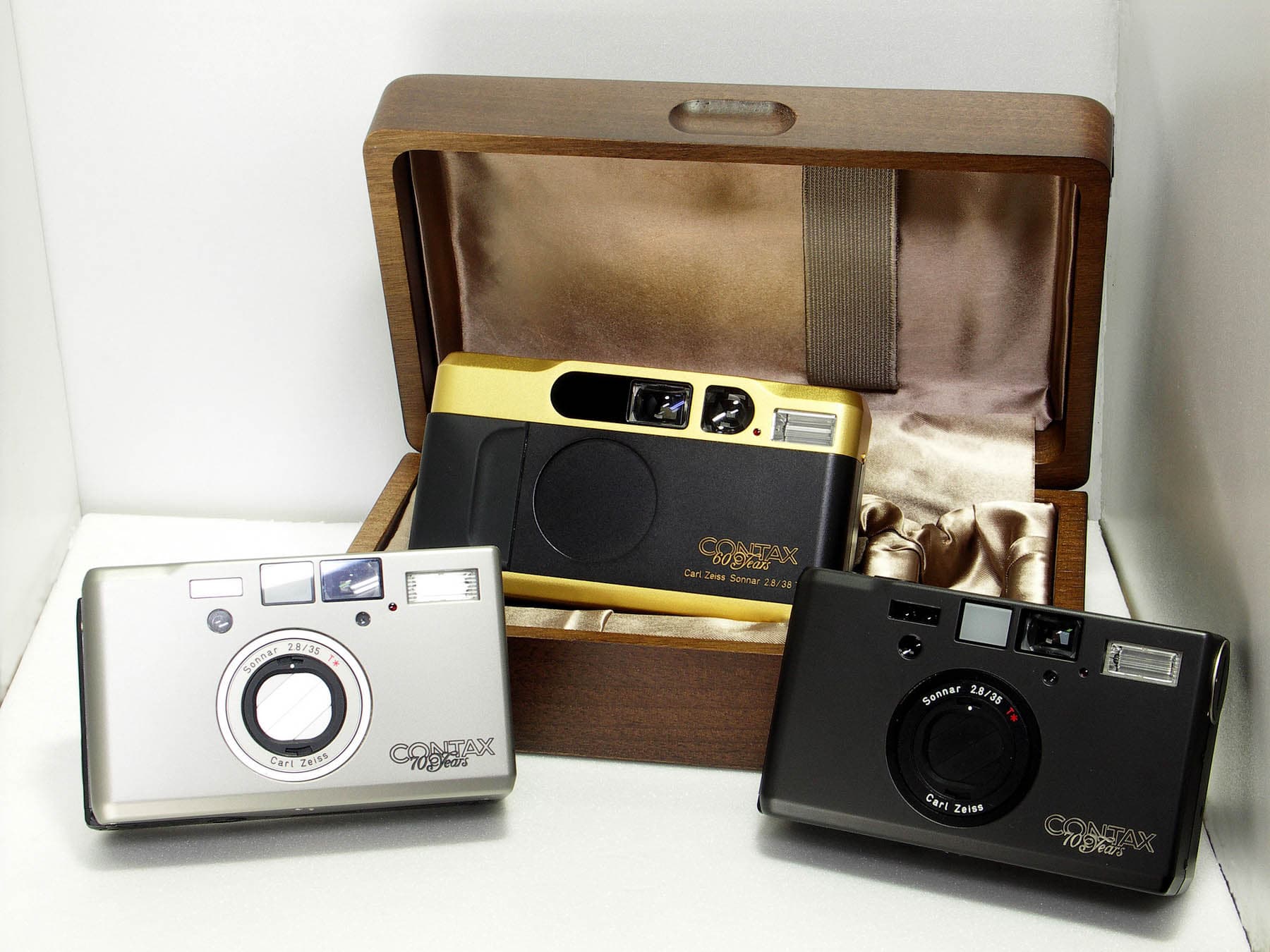
Cult status arrived around 2016 when celebrities were spotted using it, sending prices from a reasonable $400 to an absurd $1,200+. Available in silver, black, titanium gray, gold, and platinum - each commanding different premiums based purely on aesthetics.
Design & Handling
The T2 feels like it was machined from solid titanium because it basically was. At 295g with battery and film, it has heft that inspires confidence but causes hand fatigue on long shooting days. The body fits a pincer grip better than a palm grip, with rubber pads guiding your thumb and middle finger to the edges. The extending lens brushes your fingertips on power-up if you grip it like a rangefinder, which you'll learn to avoid.
The viewfinder is bright but tiny, requiring perfect eye centering to see the frame lines. Those frame lines disappear against bright backgrounds, which is frustrating. But here's the killer feature: the live metering readout displays shutter speeds constantly (1/30, 1/60, 1/125, 1/250, 1/500), with "LT" for speeds below 1/30. You learn to read light before pressing the shutter, scanning a scene and watching the numbers change. It's addictive once you understand it.
Shutter sound is quiet and discrete, perfect for street work. Film advance whirrs audibly but quickly. The camera defaults to auto-flash on every power-up (you'll curse this), and it fully rewinds film with no manual ISO override option. Mode dial doubles as power and focus selector, aperture ring is satisfying but fiddly with gloves, exposure compensation requires two hands. These are electronic quirks you either adapt to or resent forever.
How the Contax T2 Shoots: Street Photography and Travel Photography Performance
Metering & exposure behavior
Center-weighted metering nails exposure in most conditions, and that live viewfinder readout is genuinely brilliant—you scan a scene and watch shutter speeds change in real time, learning to read light intuitively. For backlit portraits, dial in +1 stop compensation and trust it. In high-contrast situations, the meter favors highlights, which means you'll occasionally blow skies but keep shadow detail. For night photography, the 1-second max shutter limits handheld work unless you're braced. I've shot natural light in open shade at 1/60 with Portra 400 and gotten 90%+ sharp frames, which is impressive for a compact.
Focusing experience
Autofocus is reliable in good light, delivering 90%+ sharp frames when there's contrast to work with. In low light or low-contrast scenes, it hunts like a confused bloodhound—you'll hear the lens racking back and forth, searching. This is where manual focus saves you. The manual focus wheel is surprisingly intuitive: click past AF to infinity, then to manual with preset distances at 5m, 2m, 1m, and 0.7m. For street photography, I preset 5m at f/8 for zone focusing and forget about it. The viewfinder shows a green dot for focus lock, which is reassuring. The 0.7m minimum focus limits portrait close-ups—you can't get tight headshots without stepping back. Autofocus lag from the lens physically moving is noticeable but acceptable for deliberate shooting.
Lens character & image quality
The Carl Zeiss Sonnar 38mm f/2.8 is razor-sharp from f/4 onwards, delivering image quality that rivals interchangeable lens systems. Wide open at f/2.8, center sharpness is excellent but corners soften until f/5.6. Vignetting is present even in bright light, adding a subtle frame that's either charming or annoying depending on your taste—I find it appealing.
Color rendition is punchy with high contrast that makes images pop. On Ektar 100, blues and greens saturate beautifully without looking artificial. On Portra 400, skin tones stay neutral with slight warmth. On Kodak Gold 200, you get the classic consumer film look but elevated—the Zeiss glass adds micro-contrast that cheap lenses can't match. The high-contrast signature can blow highlights in harsh sun, so shoot morning or late afternoon for travel photography.
Bokeh at f/2.8 is busy in cluttered backgrounds—this isn't a portrait lens. For smooth bokeh, get close (0.7-1m minimum) and ensure the background is 3-4m away with minimal detail.
Low-light performance is solid with fast film. I've shot urban photography at dusk on Tri-X 400 pushed to 800, getting sharp frames at 1/30 handheld braced against a wall. The lens is fast enough for available light work.
Known issues: minimal flare resistance. Shooting into the sun produces veiling flare that kills contrast. I've gotten sunstars at f/11-f/16, but expect haze. No distortion or chromatic aberration detected across twelve rolls, which is impressive optical performance.
Film pairings that sing
- Portra 400 for portraits and travel: Zeiss contrast balances Portra's soft tonality for creamy skin tones with punchy colors
- Ektar 100 for landscapes and urban photography: contrast stacks beautifully, delivering saturated blues and greens
- Kodak Gold 200 for everyday shooting: affordable and the Zeiss lens elevates it above typical consumer film results
- Tri-X 400 for black and white: high contrast pairs perfectly with Tri-X grain for classic street photography
Best Uses: Urban Photography, Portrait Photography, and More
Best at: Street photography (quiet shutter, zone focus), travel photography (pocketable, excellent optics), urban photography (architectural details), portrait photography (environmental portraits at 0.7m+), everyday documentation (aperture priority)
Struggles with: Night photography (1s max shutter), close-focus work (0.7m minimum), fast action (AF lag), low-light autofocus (hunts), harsh midday sun (blows highlights)
If this is you, pick this body:
- "I want Zeiss rendering without an interchangeable lens system" → Contax T2
- "I need faster autofocus" → Contax T3
- "Budget-conscious but want 85% of the quality" → Olympus MJU-II
Contax T2 vs Contax T3, Olympus Mju II, and Yashica T4
If you're considering the T2, you're also looking at the Contax T3, Olympus MJU-II, and Ricoh GR1. Let's be honest about the alternatives.
The T3 offers 35mm f/2.8 (wider angle), faster autofocus that doesn't hunt as much, and smaller size. But the T2's 38mm lens has more character and that Sonnar rendering. The T3 also costs $1,500-2,500, which is absurd for what amounts to incremental improvements.
The MJU-II delivers sharp 35mm f/2.8 results at a fraction of the cost—85% of T2 quality for 20% of the price. It's plastic instead of titanium, lacks manual controls, but it just works reliably. Most people should buy this instead.
The Ricoh GR1 has genuinely better ergonomics and a 28mm f/2.8 lens that's excellent, but reliability issues plague the entire series. LCD failure is common, and finding a working copy is harder than it should be.
Choose the T2 for premium titanium build, aperture priority control, and that specific Zeiss Sonnar rendering. Choose the T3 if you want the latest version and have money to burn. Choose the MJU-II to save $700-900 and still get excellent images. The T2 justifies its price through build quality and control, but cheaper alternatives deliver outstanding results for most shooters.
* Prices as of November 2025. Market fluctuates based on condition and celebrity influence.
| Camera | Why choose it | Where it loses vs Contax T2 | Typical used price* |
|---|---|---|---|
| Contax T3 | Smaller body, 35mm lens, faster AF | Less lens character, higher price, plastic body | $1200-1800 |
| Olympus MJU-II | Sharp 35mm f/2.8, lightweight, reliable | Plastic build, no aperture control, less prestige | $200-350 |
| Ricoh GR1 | 28mm f/2.8, excellent ergonomics, snap focus | Reliability issues (LCD failure common), harder to find working | $400-600 |
Is the Contax T2 Worth It in 2025?
As of November 2025, the T2 sells for $800-1,200, up from $400-500 in 2019. The price spike came from celebrity endorsements and the film resurgence—people saw it on Instagram and prices tripled. Is it overhyped? Partially, yes. The Olympus MJU-II delivers 85% of the image quality at $200-350. What you're actually paying for with the T2: titanium build that'll outlast you, aperture priority control, manual focus override, and that Zeiss pedigree with all the optical character that brings.
Worth it for experienced photographers who genuinely value premium build and Zeiss rendering, and can absorb the risk of electronic failure (no repair support exists for 34-year-old electronics). Not worth it if you're buying on hype, stretching financially, or won't actually use the manual controls. Be honest with yourself: will you shoot aperture priority, or just leave it on auto? If the latter, buy the MJU-II and save $700+.
Alternatives to consider: A Nikon FM2 with 35mm f/2 offers interchangeable lenses for similar money and mechanical reliability. The Olympus MJU-II saves you $700+ and delivers excellent results. The Ricoh GR1 offers better ergonomics for $400-600 if you can find a working copy. The T2 is the right camera for the right photographer, but it's definitely not for everyone.
The Bottom Line
Buy it if
- You shoot regularly, value premium build and manual controls, can afford electronic failure risk, and want Zeiss 38mm rendering
Skip it if
- You're new to film (start with MJU-II), stretching your budget (failure risk too high), or shoot low light (AF struggles, 1s max shutter)
Consider it if
You're choosing between T2 and T3 (T2 has more lens character, T3 better ergonomics), or want a premium compact under $900
Frequently Asked Questions
Is the Contax T2 worth it in 2025?
In November 2025, the Contax T2 sells for $800-1200. It's worth it for experienced photographers who value titanium build, aperture priority, and Zeiss rendering, and can afford the risk of electronic failure. If you're buying on hype or stretching financially, the Olympus MJU-II delivers 85% of the quality at $200-350. In short, if you shoot regularly and specifically want the T2's premium build and manual controls, it will delight you; otherwise, cheaper options deliver excellent results.
Contax T2 vs Contax T3: which is better?
The T3 has a 35mm lens (vs T2's 38mm), faster autofocus, and smaller size. The T2 has more lens character, titanium build (T3 is plastic), and lower price. Choose the T2 if you prefer 38mm focal length, want titanium construction, and value lens character over clinical sharpness. Choose the T3 if you need 35mm, want faster operation, and prefer smaller size. Both are excellent; it depends on your priorities.
What are common problems with the Contax T2?
The most common issues are: autofocus hunting in low light or low-contrast scenes, battery connection problems causing camera lock-up mid-shot, fingers hitting the extending lens on power-up, and viewfinder too small to see frame lines clearly. Before buying, test autofocus in various lighting, check battery contacts for corrosion, and factor in that no repair support exists (when it breaks, it's a paperweight).
Which film should I start with?
For the Contax T2, start with Kodak Portra 400 or Kodak Gold 200. Portra 400 handles the camera's high-contrast rendering beautifully, delivering creamy skin tones and balanced colors. Kodak Gold 200 is affordable and the Zeiss lens elevates it above typical consumer film results. Both are forgiving of exposure mistakes and widely available.
Can the Contax T2 handle street photography?
Yes, the T2 handles street photography well. The quiet shutter works for candid moments, zone focusing at 5m/f8 eliminates autofocus lag, and the 38mm focal length is versatile for environmental portraits and scenes. The camera's weight and pincer grip take adjustment, but once adapted, it's a capable street camera. Autofocus in low light is the main limitation.
How does the Contax T2 autofocus work?
The T2 uses center-point autofocus that needs solid contrast to lock focus. Half-press the shutter to focus and lock, then recompose. In good light, hit rate is 90%+ sharp frames. In low light or low-contrast scenes, it hunts. Manual focus mode offers preset distances (infinity, 5m, 2m, 1m, 0.7m) with viewfinder indicators (green dot for focus lock, red arrows showing which direction to turn the wheel).
Why is the Contax T2 so expensive?
Prices spiked from $400-500 (2019) to $800-1200 (2025) due to celebrity endorsements (Kendall Jenner, fashion photographers) and the film resurgence. You're paying for: titanium build, Carl Zeiss 38mm f/2.8 lens, aperture priority, and cult status. Is it overhyped? Partially. Cheaper alternatives (Olympus MJU-II at $200-350) deliver 85% of the quality, but the T2 offers premium build and manual controls those cameras lack.
What's the minimum focus distance?
0.7m (about 2.3 feet), same as Leica M cameras. This limits close-up portraits and detail shots. For tight portraits, you'll need to stand farther back and crop, or choose a different camera. The 0.7m limit is fine for environmental portraits and street photography but frustrating for macro work or intimate portraits.
Does the Contax T2 work without batteries?
No, the T2 is fully electronic and requires one CR123A battery for all functions (metering, autofocus, shutter, film advance). When the battery dies, the camera is inoperable. Battery life is good (several months of regular shooting), but always carry a spare. This is a key risk: when electronics fail (and they will eventually), there's no repair support.
Related reading
Related Topics
Join the iOS Beta
Join the beta to be the first to experience authentic film photography with Daydream Film.