
Camera Reviews
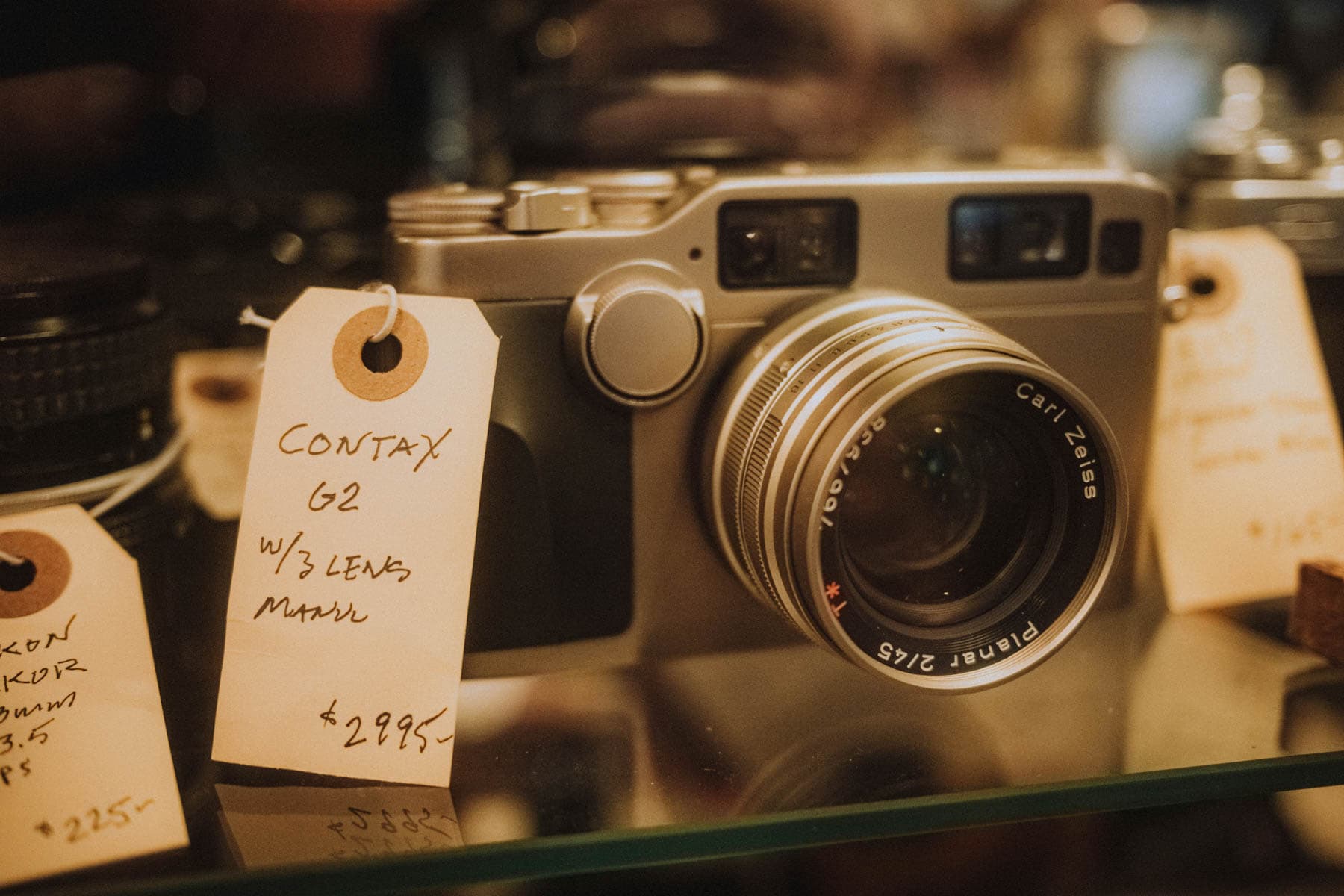
Contax G2 Review: The Autofocus Rangefinder with Legendary Zeiss Glass
Daydream Editorial
· 8 min read
Verdict
The Contax G2 is an autofocus rangefinder delivering 1/6000s shutter, 4fps motor drive, and legendary Carl Zeiss lenses in a titanium body. Released 1996, it combines rangefinder compactness with SLR automation—dual autofocus, aperture priority, through-the-lens metering. The 45mm f/2 Planar is among the sharpest lenses ever made. Manual focus is awkward (front dial), and the viewfinder is small. Electronics mean eventual failure. But for autofocus accuracy and lens quality, the G2 is exceptional. Best value: $1,800-2,000 with 45mm (December 2025).
Film photographers debate whether the Contax G2 is a "real" rangefinder: some call it the advanced rangefinder Leica should have made with autofocus and Zeiss glass, while purists dismiss it as an "anti-rangefinder" that abandons classic manual focus for electronic automation. The debate centers on whether modern convenience enhances or betrays the rangefinder experience.
Background & Key Features
Kyocera released the Contax G2 in 1996 with a clear mission: build the rangefinder that Leica should have made but was too stubborn to attempt. While Leica clung to manual focus and tradition like it was still 1954, Contax bet that photographers actually wanted autofocus, modern features, and Carl Zeiss glass in a compact body. The G2 was their answer—an autofocus rangefinder that didn't apologize for being modern.
The specs read like a wish list: titanium body available in three finishes (champagne, black paint, black chrome—each with its own devoted following), dual autofocus combining active infrared with passive phase-detection for near-instant lock, a blazing 1/6000s maximum shutter that makes the Leica M6's 1/1000s look quaint, 4fps motor drive, aperture priority automation, TTL metering, and a viewfinder that automatically adjusts magnification to match whatever lens you mount. Flash sync at 1/200s is respectable. Seven Carl Zeiss lenses cover everything from 16mm to 90mm, plus there's a 35-70mm zoom if you're into that sort of thing. Production ran until 2005, when Kyocera decided to exit the camera business entirely.
Compared to the G1 from 1994, the G2 brought genuinely faster autofocus (the G1's passive-only system could hunt like a confused bloodhound), that ridiculous 1/6000s shutter, a larger viewfinder, and ergonomic refinements throughout. It's objectively the better camera. At $1,800-2,000 for body and 45mm Planar in December 2025, you're paying serious money—Leica M6 money, actually—for what Contax called "the modern rangefinder." Whether it delivers on that promise depends entirely on what you value in a camera and how you feel about electronics that will eventually fail.
Design & Handling
Pick up a G2 and the first thing you notice is density—540g with the 45mm lens feels substantial without being heavy, like holding a very expensive paperweight that happens to take photos. The compact form factor matches Leica M dimensions almost exactly, which was clearly intentional. That champagne finish? It's wildly polarizing. Some people call it elegant and sophisticated, while others say it looks like grandma's point-and-shoot from 1978. Black versions command a 40% premium for a reason. Build quality throughout is exceptional in that late-90s Japanese way where every dial clicks deliberately, every control feels precisely damped, and mounting a lens produces this satisfying mechanical clunk that makes you smile every time.
Top-plate controls are intelligently designed: large exposure compensation dial with no lock (thank you, finally), shutter speed dial with push-button selector that's intuitive once you learn it, ISO and drive mode dial. AE lock integrates cleverly into the on/off switch—push it toward "lock" and your exposure freezes. Back-button focus sits perfectly under your thumb, toggling between single AF, continuous AF, and manual focus. The manual focus wheel lands under your middle finger on the front, which is fine though it'll never feel as natural as twisting a lens barrel. Aperture ring lives on the lens where it belongs.
Here's the controversial part: the viewfinder is small. Not "a bit small"—legitimately 50% smaller than a Leica M6. It's bright and contrasty with excellent optics, and the auto-adjusting magnification is genuinely clever engineering (mount the 28mm, see a 28mm view; mount the 90mm, see a 90mm view). Parallax correction happens automatically. The LCD overlay shows shutter speed, focus indicator, and exposure compensation, but inexplicably not aperture. You have to look at the lens barrel. Why? Who knows. The motor sounds are oddly pleasant—autofocus sounds like a damped dental drill, film advance whirrs at 4fps like a tiny turbine.
How the Contax G2 Shoots: Street Photography and Travel Photography Performance
Metering & exposure behavior
The TTL center-weighted metering just works, consistently and accurately, in that boring reliable way that makes you forget it exists. Exposure range runs from 1/6000s to 16 seconds, and in aperture priority mode (which is how most people shoot this camera), the hit rate is exceptional—shooting 36 perfect frames per roll is common, not lucky. If you understand exposure compensation and aren't afraid to use it, you'll get flawless results. For street photography, the G2 nails exposure instantly even in tricky mixed lighting. High-contrast travel scenes? Dial in +1 stop and trust it.
That 1/6000s maximum shutter is a genuine game-changer. You can shoot wide open at f/2 in bright daylight without ND filters, which gives you that shallow depth of field even in harsh midday sun. The Leica M6 tops out at 1/1000s, forcing you to stop down or add filters like it's 1975.
Focusing experience
The dual autofocus system is genuinely fast and accurate in a way that feels almost magical for a film camera from 1996. Active infrared triangulation handles close distances (under 3m) and low-contrast subjects where passive systems would hunt endlessly. Passive phase-detection handles longer distances with precision. The systems work together seamlessly for a 90%+ hit rate. Focus locks instantly—virtually no hunting, no hesitation, just beep and you're locked. Longer lenses like the 90mm take slightly longer than wide lenses, but we're talking fractions of a second.
Three focus modes cover different shooting styles: Single AF locks focus and won't fire unless it's achieved focus—this ensures sharp shots but can be frustrating if you're trying to shoot through glass. Continuous AF tracks moving subjects and fires regardless of focus confirmation—useful for action. Manual Focus uses that front dial instead of a lens ring—awkward compared to classic rangefinders.
The autofocus has one spot (center frame), which sounds limiting but works fine in practice. Use the focus-recompose technique: center your subject, half-press or press back-button focus to lock, recompose, then shoot. For street photography, this becomes second nature after a few rolls.
Manual focus is the G2's biggest weakness. The front dial feels electronic and disconnected, with no tactile feedback. There's no rangefinder patch to confirm focus visually. The good news? With autofocus this good, you'll rarely need manual focus anyway.
Lens character & image quality
Let's talk about why people actually buy this camera: the Carl Zeiss G-mount lenses are among the best ever made for 35mm photography, full stop. They're clinical, sharp, and contrasty—scientific instruments more than soft artist's tools. If you want dreamy vintage character, look elsewhere. If you want modern optical perfection, this is it.
The 45mm f/2 Planar is genuinely legendary—for years it was rated the world's highest-performing standard lens by multiple testing labs. Impeccably sharp corner to corner even wide open at f/2, with zero distortion, incredible contrast, and color rendition that makes you question whether you need digital. The rendering is three-dimensional in a way that's hard to describe—subjects pop from backgrounds with this separation that feels almost holographic. On Portra 400, skin tones are perfect without being clinical. On Ektar 100, colors are saturated but never garish. On Tri-X 400, contrast is strong and punchy. This lens alone justifies the G2 system.
The 28mm f/2.8 Biogon is the sharpest 28mm available in any format, period. Minimal distortion, clean corner to corner, perfect for street and travel photography. The 90mm f/2.8 Sonnar delivers gorgeous portraits with that perfect transition from focus to blur that makes Zeiss Sonnars famous. It's just sharp enough wide open to flatter subjects, and by f/4 it's an optical scalpel.
The 21mm f/2.8 Biogon is exceptional for an ultra-wide—it actually creates shallow depth of field at f/2.8, which is unusual. The 35mm f/2 Planar renders classically like a pre-ASPH Leica Summicron.
All lenses feature Zeiss T* multicoating for optimal light transmission—no flare, perfect color, zero distortion.
Film pairings that sing
- Kodak Portra 400 for versatile shooting with beautiful skin tones and highlight rolloff
- Fuji Reala for natural color rendition (discontinued but excellent if found)
- Kodak Ektar 100 for saturated travel photography with exceptional sharpness
- Kodak Tri-X 400 for black and white street photography with strong contrast
- Ilford Delta 100 for fine-grained black and white with excellent detail
Best Uses: Street Photography, Travel Photography, and Portrait Photography
Best at: Street photography (fast autofocus, compact), travel photography (lightweight, reliable), portrait photography (45mm and 90mm excel), wedding photography (discrete, fast), documentary work
Struggles with: Classic rangefinder experience (no manual focus ring, small viewfinder), extreme low light (passive AF struggles), long-term reliability (electronics will fail)
If this is you → pick this body:
- "I want autofocus with Zeiss quality" → Contax G2
- "I need classic rangefinder" → Leica M6 ($1,500-2,500)
- "I want cheaper autofocus" → Contax G1 ($800-1,200)
Contax G2 vs Contax G1, Leica M6, and Konica Hexar AF
The Contax G1 offers similar Zeiss lenses at $800-1,200 but has slower autofocus, 1/2000s shutter, and clunkier ergonomics. The G2 is objectively better—faster AF, 1/6000s shutter. Worth the extra $1,000 for professional use.
The Leica M6 offers classic rangefinder manual focus, larger viewfinder, and mechanical reliability at $1,500-2,500 (body only). Maximum shutter is 1/1000s. Lenses cost $1,000-3,000. Choose Leica for manual control. Choose G2 for autofocus.
The Konica Hexar AF offers fixed 35mm f/2 lens at $300-500. Quieter, simpler, but no interchangeable lenses. Choose Hexar AF for budget. Choose G2 for lens flexibility.
* Prices as of December 2025. Contax G2 prices have increased significantly since 2020.
| Camera | Why choose it | Where it loses vs G2 | Typical used price* |
|---|---|---|---|
| Contax G1 | Same Zeiss lenses, $1,000 cheaper | Slower AF, 1/2000s max shutter | $800-1,200 |
| Leica M6 | Classic manual focus, larger viewfinder | No autofocus, 1/1000s max | $1,500-2,500 |
| Konica Hexar AF | Quieter, simpler, much cheaper | Fixed lens, no flexibility | $300-500 |
Is the Contax G2 Worth It in 2025?
As of December 2025, the Contax G2 sells for $1,800-2,000 (body + 45mm Planar), up from $1,200-1,400 in 2020. Prices have increased significantly due to the film resurgence and people finally realizing what they had. This is expensive—Leica M6 money, actually—for a camera with electronics that will eventually fail and no factory service since 2005. Let's talk honestly about value.
It's worth it if you shoot street, travel, or portrait photography regularly and genuinely value autofocus speed with Zeiss optical quality. The 45mm Planar alone justifies the system—it's genuinely one of the best lenses ever made for 35mm, and having autofocus with glass this good is rare in film photography. The autofocus is faster than any other film rangefinder, the 1/6000s shutter opens creative possibilities that Leica can't match, and the overall package delivers professional results. For working photographers or serious enthusiasts who shoot multiple rolls per month, the G2 delivers value.
Not worth it if you want the classic rangefinder manual focus experience (get a Leica M6 and enjoy that rangefinder patch), need mechanical reliability that'll last decades without repairs (electronics will fail, it's just a question of when), or shoot casually a few times per year (get a Contax G1 for $800-1,200 or a Konica Hexar AF for $300-500 and pocket the difference).
Here's the uncomfortable truth: at $1,800-2,000, you're paying for autofocus accuracy, that ridiculous 1/6000s shutter, and legendary glass in a compact package. It's fair value for professional use or if you're building a serious film system. But you're also buying a 30-year-old electronic camera with no factory support, so budget for eventual repairs or replacement.
The Bottom Line
Buy it if
- You shoot street, travel, or portrait photography professionally and value autofocus speed with Zeiss quality. Accept eventual electronic failure.
Skip it if
- You want classic rangefinder manual focus (get Leica M6) or shoot casually (get Contax G1 for $1,000 less).
Consider it if
You want the best autofocus rangefinder ever made or shoot in bright light (1/6000s shutter allows f/2 in daylight).
Frequently Asked Questions
Is the Contax G2 worth it in 2025?
In 2025, the Contax G2 sells for $1,800-2,000 (body + 45mm lens). It's worth it for professional street, travel, and portrait photographers who value autofocus speed with Zeiss quality. The 45mm Planar is genuinely one of the best lenses ever made. The autofocus is faster than any other film rangefinder. Not worth it for casual shooters—get Contax G1 ($800-1,200) or Konica Hexar AF ($300-500) instead.
Contax G2 vs G1 – which is better?
The G2 is objectively better: faster dual autofocus (active + passive versus G1's single passive), 1/6000s shutter versus 1/2000s, improved ergonomics, better viewfinder. The G2 costs $1,800-2,000 versus G1 at $800-1,200. Both use the same legendary Zeiss lenses. Choose G2 for professional use. Choose G1 to save $1,000 with slightly slower performance.
Which Contax G2 lenses are best?
The 45mm f/2 Planar is legendary - the world's highest-rated standard lens for years, impeccably sharp with zero distortion. The 28mm f/2.8 Biogon is the sharpest 28mm ever made. The 90mm f/2.8 Sonnar is excellent for portraits. Start with the 45mm Planar—it's the cornerstone of the system. Add 28mm for street photography or 90mm for portraits.
How does Contax G2 autofocus work?
The G2 uses dual autofocus: active infrared triangulation (close distances under 3m, low-contrast subjects) and passive phase-detection (longer distances, normal contrast). The systems work together for 90%+ hit rate. Focus locks instantly with virtually no hunting. Single AF mode won't fire unless focused (ensures sharp shots). Continuous AF tracks moving subjects. The autofocus has one center spot—use focus-recompose technique.
Contax G2 vs Leica M6 – which is better?
Different shooting experiences. The Contax G2 offers autofocus, 1/6000s shutter, motor drive, and Zeiss lenses at $1,800-2,000. The Leica M6 offers classic rangefinder manual focus, larger viewfinder, mechanical reliability, and 1/1000s shutter at $1,500-2,500 (body only, lenses $1,000-3,000 each). Choose G2 for autofocus speed and modern convenience. Choose M6 for manual control and classic rangefinder experience.
What are common problems with the Contax G2?
Common issues: small viewfinder (biggest complaint), electronic failure (no factory service since 2005, complex repairs expensive), battery dependency (completely electronic, won't work without CR2 batteries), awkward manual focus (front dial, not lens ring), no aperture readout in viewfinder, LCD screens not backlit (hard to read in dark). The electronics will eventually fail—budget for repairs or replacement. Buy from reputable sellers with return policies.
Is the Contax G2 good for street photography?
Yes, the Contax G2 excels at street photography. Fast autofocus locks instantly, quiet shutter is discrete, compact form factor is unobtrusive, 28mm Biogon is perfect for street work, aperture priority handles changing light. The 1/6000s shutter allows shooting wide open in bright daylight. The motor drive is fast but noisy—use single-shot mode for discrete shooting. The small viewfinder takes adjustment but becomes manageable with practice.
Can you use Contax G2 lenses on other cameras?
No, Contax G lenses are proprietary to G-mount bodies (G1 and G2 only). The autofocus motor is in the camera body, not the lens. Adapters exist for digital cameras (Sony E-mount, Fuji X-mount) but lose autofocus—manual focus via adapter is awkward. The lenses are optimized for G-mount bodies. If you want Zeiss lenses for other systems, look at Zeiss ZM (Leica M-mount) or ZF/ZE (SLR mounts).
How many shots per roll on Contax G2?
The Contax G2 shoots 36 exposures per roll of 35mm film (or 24 for shorter rolls). The motor drive advances film automatically at up to 4fps in continuous high mode. The motor also auto-rewinds when the roll is finished. Battery life is good—expect 50+ rolls per set of CR2 batteries. Always carry spare batteries as the camera is completely electronic.
Related reading
Related Topics
Join the iOS Beta
Join the beta to be the first to experience authentic film photography with Daydream Film.