
Camera Reviews
Olympus Trip 35 Review: The Solar-Powered Travel Legend
Daydream Editorial
· 8 min read
Verdict
The Olympus Trip 35 delivers excellent image quality through its 40mm f/2.8 Zuiko lens and requires zero batteries thanks to selenium cell metering. The zone focus system takes practice, but rewards patient shooters with sharp, characterful images.
The Olympus Trip 35 divides photographers into two camps: those who swear it's the perfect travel companion with its battery-free operation and sharp Zuiko lens, and those who struggle with its zone focus system and limited ISO range. With over 10 million units sold between 1967 and 1984, this solar-powered compact earned legendary status, but does it deserve the hype in 2025?
Background & Key Features
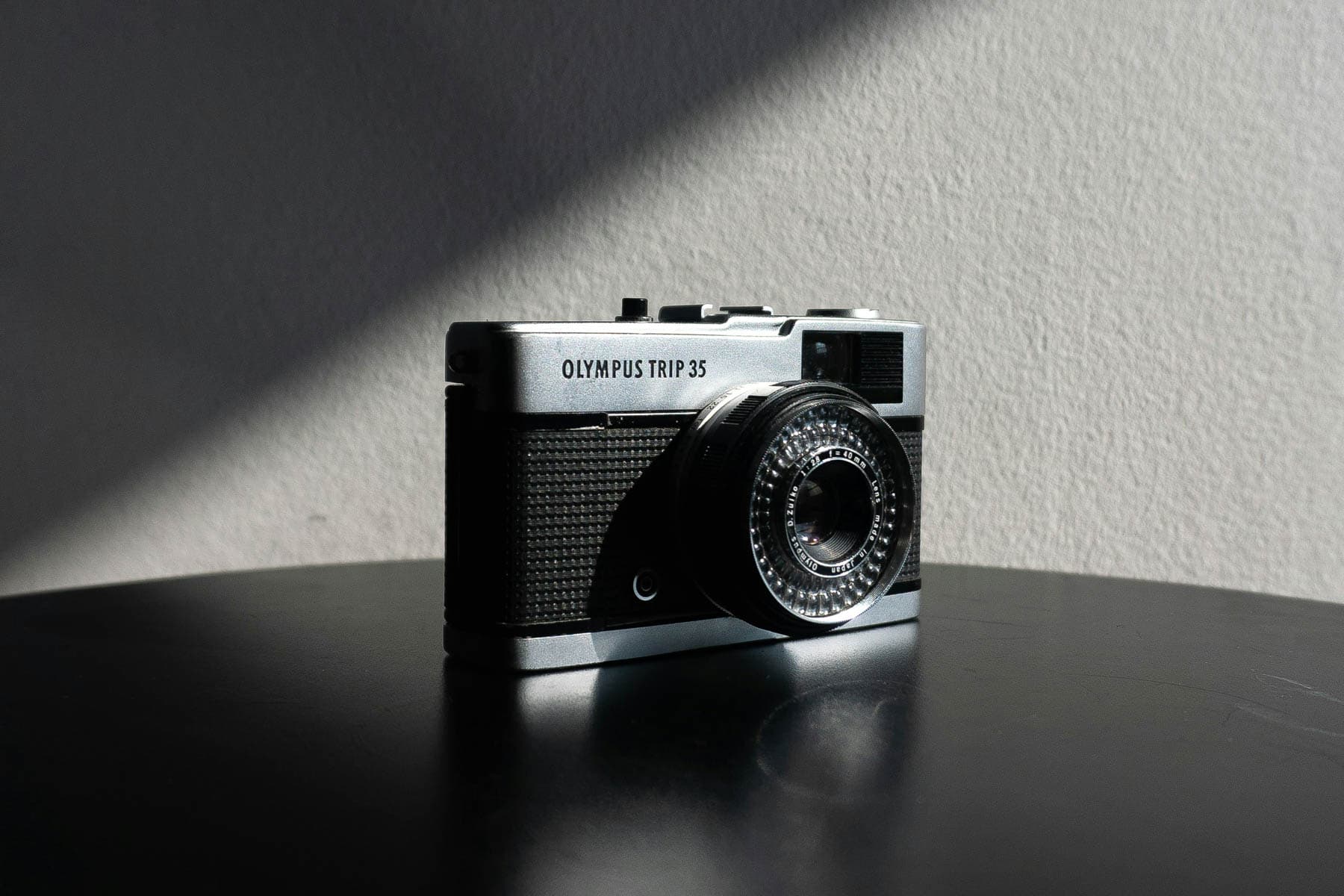
Olympus released the Trip 35 in 1967 as their answer to the vacation camera market, and it remained in production for 17 years, selling an estimated 10 million copies. That's a massive success by any measure. This 35mm compact features a fixed 40mm f/2.8 D.Zuiko four-element lens, automatic exposure via selenium cell metering, and all-metal construction weighing 390 to 410 grams depending on the version. The camera offers two shutter speeds (1/40s and 1/200s) selected automatically, apertures from f/2.8 to f/22, and zone focusing with four distance settings marked by pictograms.
The selenium light meter ring surrounds the lens, powering the camera from ambient light alone. No batteries, ever. The Trip earned cult status among photographers like David Bailey, who appreciated its simplicity and reliability. It was available primarily in silver with a rare black brass version produced from 1967 to 1969 that now commands premium prices.
Design & Handling
The Trip 35 sits comfortably in one hand at 390 grams, with a metal body that feels genuinely solid without being heavy. Compact dimensions (116mm x 70mm x 57mm) slip into jacket pockets, though the lens protrudes enough to prevent true pocket carry. The shutter button positions naturally under your index finger with the film advance wheel accessible on the back, which is smart ergonomics for 1967.
The viewfinder is bright with frame lines and parallax marks, though the small window requires good eye alignment to see the full frame. The "Judas window" below the viewfinder shows your current aperture and focus setting, which is helpful for confirming settings. Controls are minimal: ISO dial on the outer lens ring, aperture ring at the base (set to "A" for auto mode), and zone focus ring with four pictographic settings. Everything clicks with mechanical precision that feels satisfying.
The shutter is quiet for a leaf design, excellent for candid street work without drawing attention. Film advance is smooth and quick. One quirk: the camera fires without film loaded, so always check your rewind tension to confirm film is advancing. The red flag locks the shutter in low light, preventing wasted frames but frustrating shooters who want to push the limits.
How the Olympus Trip 35 Shoots: Travel Photography and Street Photography Performance
Metering & exposure behavior
The selenium cell metering is surprisingly accurate in good light, handling bright sun to open shade without issue. The camera automatically selects aperture and shutter speed (1/200s or 1/40s), nailing exposure about 85-90% of the time. In high-contrast situations, center-weighted metering can be fooled by bright backgrounds. The red flag warning system prevents underexposure by locking the shutter when light drops below EV8, but means you can't shoot in dim conditions without flash or manual aperture mode. For natural light photography in daylight, the Trip 35 handles exposure confidently.
Focusing experience
Zone focusing is the Trip's biggest learning curve. Four pictographic settings represent approximately 1m (portrait), 1.5m (two people), 3m (group), and infinity (landscape). The system works brilliantly once you internalize distances, but early rolls will have soft shots. For street photography, set focus to the group icon (3m) at f/8-f/11 for adequate depth of field. The 40mm focal length is forgiving. Close-focus work at 1m requires precision—miss by 20cm and your subject goes soft. Distance markings help, but you'll need practice initially.
Lens character & image quality
The 40mm f/2.8 D.Zuiko is genuinely the Trip's secret weapon, a four-element Tessar-type design that punches way above its weight. Wide open at f/2.8, the lens is sharp in the center with slight corner softening that adds character to portraits rather than detracting from them. By f/5.6 to f/8, sharpness is excellent edge to edge with minimal distortion or chromatic aberration. The simple optical formula keeps contrast medium-high without harshness, which gives images a pleasing look.
Color rendition is neutral and accurate on color negative film, with pleasing saturation on Kodak Gold and Ektar that makes travel photos pop. On black and white film like Tri-X or HP5, the lens renders fine detail with smooth tonal transitions that make street photography sing. Bokeh at f/2.8 is unremarkable but inoffensive, a simple two-blade diamond aperture that doesn't distract from the subject.
Low-light performance is limited by the 1/40s minimum shutter and ISO 400 maximum, which is the camera's main weakness. At f/2.8 with ISO 400 film, you can shoot in urban evening light or well-lit interiors, but anything dimmer triggers the red flag and locks the shutter. The lens shows minimal flare when shooting into light sources, which is impressive for a 1960s design.
Film Pairings That Sing
- Kodak Gold 200 for travel and street work—forgiving latitude matches the camera's simplicity perfectly
- Portra 400 for portraits and mixed lighting—extra speed helps in marginal conditions when red flag threatens
- Tri-X 400 for black and white street photography—classic pairing that highlights the Zuiko's sharpness and contrast
- Ektar 100 for landscapes and bright conditions—fine grain maximizes the lens quality in good light
Best Uses: Travel Photography, Street Photography, and Urban Photography
Best at: Travel photography, street photography with zone focus pre-set, urban photography in daylight, documentary work, casual portraiture in good light
Struggles with: Night photography (1/40s minimum shutter and ISO 400 limit), low-light situations without flash, close-focus work under 1m, fast action
If this is you → pick this body:
- "I want reliable travel photography without batteries" → Olympus Trip 35
- "I need rangefinder precision and manual control" → Canonet QL17
- "Budget-conscious but want excellent results" → Olympus Stylus Epic
Olympus Trip 35 vs Canonet QL17, Yashica Electro 35, and Olympus Stylus Epic
The Trip 35 sits in an interesting middle ground between fully manual compacts and modern point-and-shoots. The Canonet QL17 offers a coupled rangefinder, faster f/1.7 lens, and full manual control for precise focusing and low-light work, but it's significantly larger and requires batteries. The Yashica Electro 35 delivers aperture priority automation with a 45mm f/1.7 lens but also depends on batteries. Both sacrifice the Trip's battery-free simplicity, which is the whole point.
The Olympus Stylus Epic represents the Trip's spiritual successor with autofocus and a sharp 35mm f/2.8 lens. It's smaller and easier to use, but it requires batteries and commands higher prices ($200-300 versus $100-150). The Trip 35 delivers similar image quality with mechanical charm and zero battery anxiety.
* Prices as of December 2025. Market fluctuates based on condition and seller.
| Camera | Why choose it | Where it loses vs Trip 35 | Typical used price* |
|---|---|---|---|
| Canonet QL17 | Rangefinder focusing, f/1.7 lens, manual control | Requires batteries, larger/heavier, more expensive | $150-250 |
| Yashica Electro 35 | Faster f/1.7 lens, similar automation | Battery-dependent, heavier, less portable | $80-150 |
| Olympus Stylus Epic | Autofocus, smaller size, easier operation | Requires batteries, plastic build, higher prices | $200-300 |
Is the Olympus Trip 35 Worth It in 2025?
As of December 2025, working Trip 35 cameras sell for $100-150, with the rare black brass version at $150-200. Prices have climbed from $50-80 five years ago due to film photography's resurgence. At current prices, the Trip 35 offers excellent value—proven reliability, zero battery costs, and a sharp lens. The selenium cell is the main concern; buy from reputable sellers who've tested the red flag mechanism.
Worth it if you want simple, reliable travel photography without batteries. Not worth it if you need low-light capability or precise manual focus. The Canonet QL17 offers more control for $50-100 more; the Olympus Stylus Epic delivers easier operation but costs $100-150 more and requires batteries. Bottom line: at $100-150, the Trip 35 is excellent value for daylight shooters who appreciate mechanical simplicity.
The Bottom Line
Buy it if
- You want battery-free travel photography with excellent image quality, shoot primarily in daylight, and appreciate mechanical simplicity over electronic convenience.
Skip it if
- You shoot frequently in low light, need precise manual focus control, or require faster than f/2.8. Consider the Canonet QL17 or Olympus Stylus Epic instead.
Consider it if
You're willing to learn zone focusing and accept the ISO 400 limit, or want a backup camera that never needs batteries.
Frequently Asked Questions
Is the Olympus Trip 35 worth it in 2025?
In December 2025, the Olympus Trip 35 sells for $100-150 for working copies. It's worth it for photographers who value battery-free operation, sharp image quality, and mechanical simplicity for travel and street photography. If low-light capability or precise manual focus is essential, consider the Canonet QL17 ($150-250) or save for a rangefinder. In short, if you shoot primarily in daylight and want a reliable travel companion, the Trip 35 will delight you; otherwise, the Olympus Stylus Epic offers easier operation with batteries.
Olympus Trip 35 vs Olympus Stylus Epic – which is better?
The Trip 35 offers battery-free operation, mechanical simplicity, and similar image quality to the Stylus Epic's 35mm f/2.8 lens. The Stylus Epic counters with autofocus, smaller size, and easier operation, but requires batteries and costs $200-300 (versus $100-150 for the Trip). Choose the Trip 35 if you value mechanical reliability and battery-free shooting; choose the Stylus Epic if you want autofocus convenience and don't mind battery dependence.
What are common problems with the Olympus Trip 35?
The most common issues are: dead selenium cells (the red flag doesn't appear in low light, or appears incorrectly), sticky aperture blades from old lubricant (causing incorrect exposure), deteriorated light seals (causing light leaks on film edges), and stuck film counters. Before buying, verify the red flag pops up when you cover the selenium cell ring and press the shutter—this confirms the meter works. Budget $20-40 for light seal replacement if needed.
Which film should I start with on the Olympus Trip 35?
Start with Kodak Gold 200—its forgiving exposure latitude compensates for the Trip's automatic metering, it performs well in the camera's ideal lighting conditions (daylight), and it's affordable for learning the zone focus system. The 200 ISO speed works perfectly with the camera's 1/40s and 1/200s shutter speeds in typical outdoor lighting.
Can the Olympus Trip 35 handle street photography?
Yes, the Trip 35 excels at street photography in daylight. Set the zone focus to the group icon (3m) at f/8-f/11 for deep depth of field, and the quiet leaf shutter won't draw attention. The 40mm focal length is ideal for street work—wide enough for environmental context, tight enough for subject isolation. Limitations: the red flag locks the shutter in dim conditions, and zone focus requires distance estimation practice.
How does the Olympus Trip 35 selenium meter work?
The selenium photocell ring surrounding the lens converts light energy directly into electrical current, requiring no batteries. This powers the automatic exposure system, which selects aperture (f/2.8 to f/22) and shutter speed (1/40s or 1/200s) based on available light and your ISO setting. In low light below EV8, a red flag appears in the viewfinder and locks the shutter. Selenium cells degrade over decades, so test before buying by covering the cell—the red flag should appear immediately.
What's the difference between silver and black Olympus Trip 35?
The black brass version was produced only from 1967-1969 and is much rarer, commanding $150-200 versus $100-150 for silver aluminum bodies. Functionally they're identical—same lens, same metering system, same performance. The black version has brass construction (slightly heavier and more durable) and develops attractive brassing with use. Choose black if you want rarity and aesthetics; choose silver for better value and easier availability.
Can I use the Olympus Trip 35 without the light meter?
Yes, by setting the aperture ring to any f-stop (instead of "A" for automatic), you bypass the meter and shoot at a fixed 1/40s shutter speed. This lets you shoot in low light when the red flag would normally lock the shutter, or use flash with manual aperture control. You'll need to meter externally (phone app or handheld meter) and calculate exposure manually. This mode is useful for experienced shooters but defeats the camera's simplicity for beginners.
Related Topics
Join the iOS Beta
Join the beta to be the first to experience authentic film photography with Daydream Film.