
Camera Reviews
Canon F-1 Review: The Mechanical Tank That Challenged Nikon
Daydream Editorial
· 8 min read
Verdict
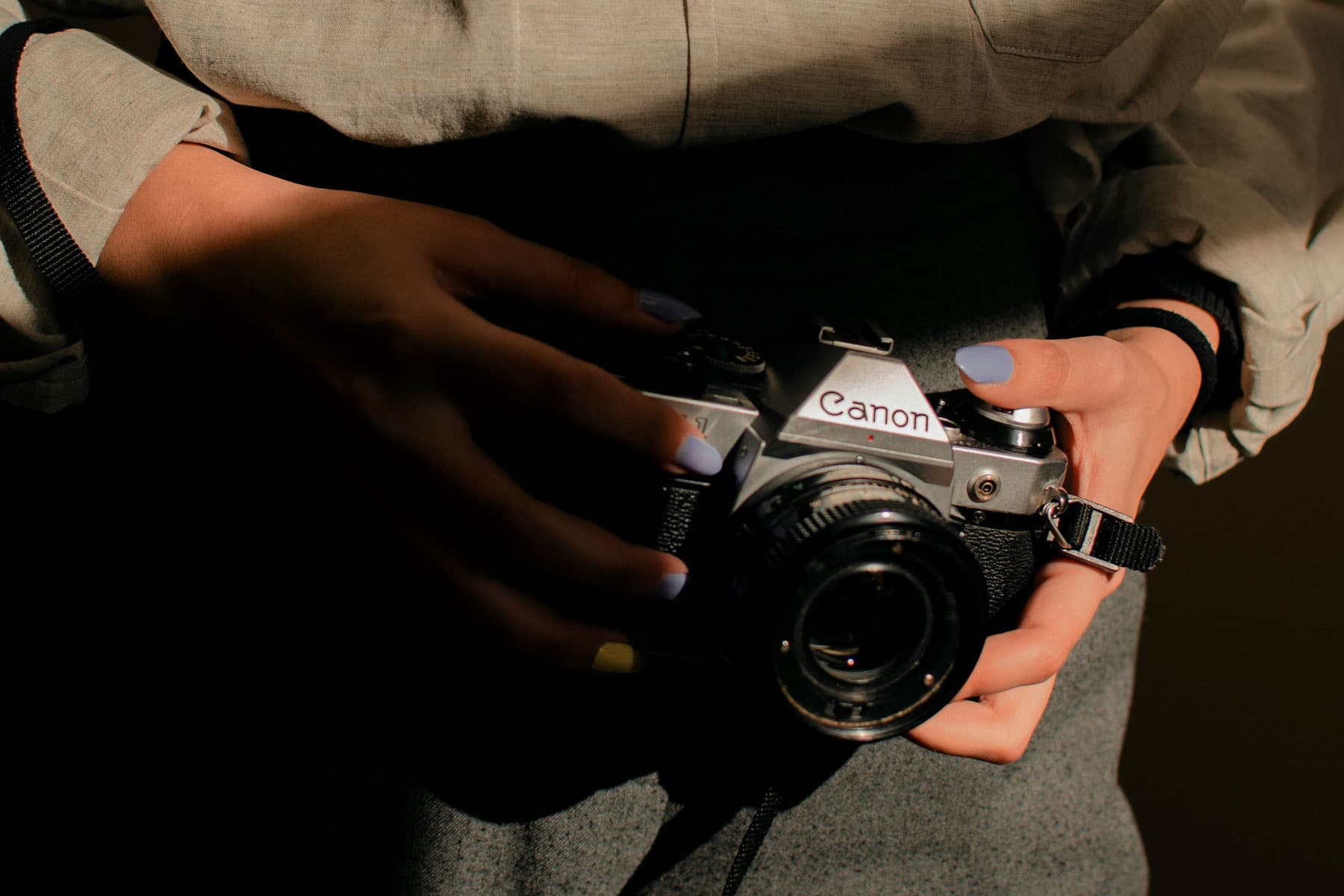
The Canon F-1 combines bulletproof mechanical construction, a modular system with interchangeable finders and screens, and compatibility with 68 excellent FD lenses. It's a fully mechanical professional SLR that works without batteries and develops character through decades of use.
Film photographers debate whether the Canon F-1 was Canon's first serious professional camera or simply the camera that finally dethroned Nikon's F-series dominance. Released in 1971 to compete directly with the Nikon F and F2, the F-1 brought professional-grade durability, modular design, and the new FD lens mount to photographers who wanted an alternative to Nikon's stranglehold on the pro market.
Background & Key Features
Canon released the F-1 in 1971 with one goal: prove they could build a professional camera that matched Nikon's legendary F and F2. Until then, pros shot Nikon. Period. The F-1 changed that conversation by delivering everything working photographers actually needed, wrapped in a brass body that could survive a war zone (and did, in several).
The specs tell part of the story: 820g of solid brass construction, fully mechanical focal-plane shutter running from 1 second to 1/2000s, flash sync at 1/60s. But the real genius is in the modular system. Swap viewfinders depending on your shooting style—the standard pentaprism gives you 97% coverage at 0.8x magnification, or go with a waist-level finder for low-angle work. Choose from 32 different focusing screens. Need a motor drive? Bolt one on. The FD breech-lock mount opens up 68 lenses ranging from a ridiculous 7.5mm fisheye to an 800mm monster.
Weather sealing handles everything from Arctic cold (-30°C) to desert heat (60°C) and 90% humidity. TTL match-needle metering works with ISO 25-2000 film. Mirror lockup, depth of field preview, 10-second self-timer—it's all there. Canon priced it to compete directly with the Nikon F2, and suddenly pros had a choice. That's the F-1's real legacy: breaking Nikon's monopoly on professional film cameras.
Design & Handling
Pick up an F-1 and you immediately understand why Canon challenged Nikon's pro dominance. At 820g, it's substantial without being punishing, and the weight distribution works beautifully whether you're mounting the compact 50mm f/1.8 or the beast of a 300mm f/2.8 L. That solid brass body underneath the black enamel? It's not just marketing. Drop this camera (please don't) and you'll dent your floor, not the F-1. Over time, the paint wears through to reveal golden brass patina—what some cameras try to fake with artificial aging, the F-1 earns honestly through decades of use.
The shutter is rubberized silk, which sounds fancy but really just means it's smooth and surprisingly quiet for a mechanical camera. There's a satisfying thunk when you fire it, the kind of sound that makes you want to shoot another frame just to hear it again.
Inside the viewfinder, things stay simple: bright view, match-needle display, microprism focusing screen. The F-1n's later split-prism design is brighter but more obtrusive—pick your poison. Controls fall exactly where your hands expect them. Shutter speed dial on top, aperture on the lens, film advance lever with a satisfying 180-degree stroke that feels like winding a mechanical watch. The self-timer doubles as depth of field preview when you push it toward the lens, which is clever until you accidentally trigger it while shooting one-handed.
That's the main ergonomic complaint: no proper hand grip means your fingers have nowhere comfortable to rest, and it's easy to bump that timer lever. Aftermarket wooden grips fix this, and honestly, they look great doing it. Film loading is straightforward but not foolproof like later Quick Load systems—you'll want to check your leader caught before closing the back. The battery powers only the meter, so when it dies (and it will), the camera keeps shooting. That's the beauty of mechanical.
How the Canon F-1 Shoots: Street Photography and Portrait Photography Performance
Metering & exposure behavior
Here's where things get old-school in the best way. The match-needle metering is dead simple: look through the viewfinder, see a needle showing the meter reading and a circle showing your aperture, then twist the shutter speed dial until they kiss. When they align, you're good to shoot. It's intuitive once you get the rhythm, though admittedly it struggles in flat, low-contrast light where modern matrix metering would save you.
The catch? That meter runs on a 1.3v mercury battery that hasn't been manufactured since the 1990s. Modern replacements exist (zinc-air or silver oxide with adapters), but honestly, many F-1 shooters just ignore the meter entirely. Sunny 16 works fine, or grab a cheap external meter. The beauty of a mechanical camera is that when the meter dies, the camera keeps shooting. The metering range covers ISO 25-2000, which handles everything from Ektar 100 to pushed Tri-X, though the F-1n later extended this to ISO 3200 for the really fast film crowd.
Manual focus performance
Manual focus on the F-1 is what you'd expect from a 1970s pro camera: no autofocus magic, just your eyes, the viewfinder, and a microprism focusing screen that works brilliantly with normal lenses but gets finicky with longer glass. The genius is in the interchangeable screens—swap to split-prism for sports, grid screens for architecture, or plain matte for wide-angle work. It's like having multiple cameras in one body, though let's be honest, most people find a screen they like and never change it.
Focus throw on FD lenses is smooth and well-damped, with just enough resistance that you're not hunting. In good light with the lens stopped down a bit, nailing focus is quick and confidence-inspiring. Wide open with fast primes? That's where you earn your keep, especially if you wear glasses. The bright viewfinder helps, but eyeglass wearers might want to track down the optional Speed Finder prism for better eye relief.
Lens character & image quality
Here's the thing about the F-1: the camera body is just the delivery system. Image quality lives or dies by your lens choice, and Canon's FD lineup gives you 68 excellent options to choose from. Early breech-lock lenses feel like they're machined from solid metal (because they basically are), while later bayonet-mount versions use more plastic but shoot identically. Don't let lens snobs tell you otherwise.
The 50mm f/1.4 is the classic pairing—beautiful rendering, smooth bokeh, sharp even wide open. The 24mm f/2.8 delivers corner-to-corner sharpness that makes it perfect for street photography and documentary work. Want to go pro? FD L lenses represent Canon's finest glass, with aspherical elements and coatings that justify their premium prices. All FD lenses meter at full aperture, which is a huge workflow advantage over stop-down metering systems.
Budget tight? Third-party options from Vivitar and Soligor offer surprisingly good optical quality at friendlier prices. You're not getting L-series performance, but you're getting sharp, usable images that won't embarrass you.
Film Pairings That Sing
- Tri-X 400 for black and white photography and street photography—classic pairing that showcases the F-1's precise mechanical operation
- Portra 400 for portrait photography with forgiving latitude and beautiful skin tones
- Kodak Gold 200 for everyday shooting—affordable and pairs perfectly with the reliable metering
- Ektar 100 for travel photography and landscapes—saturated colors and fine grain maximize lens sharpness
Best Uses: Street Photography, Portrait Photography, and Documentary Photography
Best at: Street photography with compact primes, portrait photography with fast lenses, documentary photography with reliable operation, travel photography with weather sealing, wedding photography as professional backup, architectural photography with interchangeable screens
Struggles with: Fast-moving action without motor drive, low-light metering without external meter, automated exposure modes
If this is you → pick this body:
- "I want professional mechanical reliability without battery dependence" → Canon F-1
- "I need modern autofocus and matrix metering" → Nikon F100
- "Budget allows and I want simpler mechanical operation" → Nikon FE2
Canon F-1 vs Nikon FE2, Nikon F100, and Canon FTb
The F-1 sits at the top of the mechanical pro SLR mountain, but that doesn't mean it's the right camera for everyone. Let's be real about the alternatives.
The Nikon FE2 costs $200-300 and gives you aperture priority automation, a blazing 1/4000s mechanical shutter, and operation that's just simpler. You lose the F-1's modular system and that brass-body mystique, but you gain a camera that's easier to shoot and maintain. If you don't need interchangeable finders, the FE2 makes a lot of sense.
The Nikon F100 flips the script entirely: autofocus, matrix metering, modern ergonomics, all for $150-250. It's battery-dependent and lacks that mechanical soul, but it's arguably the better tool for actually getting shots. Pride of ownership versus practical performance—pick your priority.
Here's the plot twist: the Canon FTb is the F-1's consumer sibling, and it produces nearly identical images for $100-150. Smaller, lighter, built-in hot shoe, Canon's Quick Load system that actually works. You sacrifice the 1/2000s top shutter speed and interchangeable finders, but be honest—when's the last time you needed either? For most photographers, the FTb delivers 90% of the F-1's performance at one-third the cost. The F-1 is the camera you want. The FTb is the camera you probably need.
* Prices as of December 2025. Market fluctuates based on condition and demand.
| Camera | Why choose it | Where it loses vs F-1 | Typical used price* |
|---|---|---|---|
| Nikon FE2 | Aperture priority, 1/4000s shutter, simpler operation | No modular system, smaller lens selection | $200-300 |
| Nikon F100 | Autofocus, matrix metering, modern features | Battery dependent, electronic complexity | $150-250 |
| Canon FTb | 90% of F-1 performance, built-in hot shoe, lighter | No interchangeable finders, 1/1000s max shutter | $100-150 |
Is the Canon F-1 Worth It in 2025?
As of December 2025, Canon F-1 bodies run $250-350 for working copies, with pristine examples hitting $400. That's real money for a 50-year-old camera, so let's talk honestly about value.
The F-1 commands this premium for its modular system, professional build, and that brass construction that ages like a fine whiskey. But here's the uncomfortable truth: most photographers never swap finders, never bolt on a motor drive, and never push the camera to its professional limits. They're paying for capability they'll never use. Meanwhile, the Canon FTb sits at $100-150 producing identical images with better ergonomics for everyday shooting.
So when is the F-1 worth it? If you genuinely need professional mechanical reliability for paid work. If you're building a serious Canon FD system and want the flagship. If you value cameras that develop character through decades of use, where the worn brass becomes part of the story. If you're the type who appreciates mechanical craftsmanship for its own sake.
Not worth it? If you just want great photos from FD lenses—buy the FTb and pocket the difference. If you need modern features, the Nikon F100 gives you more camera for less money, even if it lacks mechanical soul.
Bottom line: at $250-350, the F-1 is a solid choice for photographers who value mechanical craftsmanship over automation. Just make sure you're buying the camera you'll actually use, not the camera you think you should want.
The Bottom Line
Buy it if
- You want professional mechanical reliability, plan to build a Canon FD system, or value cameras that develop character through use.
Skip it if
- You want automated exposure modes, need autofocus, or can get similar results from the Canon FTb for less money. Consider the FTb instead.
Consider it if
You're a documentary photographer who needs reliability, shoot in extreme conditions, or want a modular professional system.
Frequently Asked Questions
Is the Canon F-1 worth it in 2025?
In December 2025, the Canon F-1 sells for $250-350 for working copies. It's worth it if you value professional mechanical reliability, modular design, and brass construction that develops character through use. However, the Canon FTb delivers nearly identical image quality for $100-150, making it better value for most photographers. The F-1's premium buys you interchangeable finders, professional accessories, and weather sealing that the FTb lacks. If you need those features or simply want the best mechanical Canon made, the F-1 justifies its price.
Canon F-1 vs Canon FTb – which is better?
The FTb delivers 90% of the F-1's performance at one-third the cost. Both use the same FD lenses and produce identical images. The FTb adds a built-in hot shoe, Quick Load film system, and lighter weight. The F-1 counters with interchangeable finders, 1/2000s top shutter speed (vs 1/1000s), professional weather sealing, and modular accessories. Choose the FTb unless you specifically need the F-1's modular system or professional features. Most photographers will be happier with the FTb's practicality and lower price.
What are common problems with the Canon F-1?
The most common issues are: meter reliability due to outdated mercury batteries (use modern replacements or shoot without meter), light seals deteriorating after 50+ years (easy DIY replacement), shutter speeds becoming inaccurate (requires CLA), and film advance lever stiffness from old lubricants. The brass body is nearly indestructible, but the black enamel paint chips to reveal brass underneath (many consider this desirable "brassing"). Before buying, verify shutter speeds sound accurate, test the meter if working, and check for smooth film advance.
Which lenses work best with the Canon F-1?
All Canon FD lenses work perfectly with full-aperture metering. The 50mm f/1.4 delivers beautiful rendering for portrait photography and street photography. The 24mm f/2.8 provides excellent sharpness for travel photography and documentary work. The 85mm f/1.8 is a portrait photography favorite with smooth bokeh. FD L lenses represent Canon's professional glass with superior optics. Third-party options from Vivitar and Soligor offer affordable alternatives. Avoid the rare 24mm f/1.4 aspherical unless you have $80,000 to spare.
Can the Canon F-1 handle street photography?
Yes, the F-1 excels at street photography despite its weight. The mechanical operation is silent and smooth, drawing less attention than electronic cameras. The bright viewfinder and accurate manual focus allow quick framing and focusing. Pair with the compact 35mm f/2 or 50mm f/1.8 for a manageable street photography setup. The reliable mechanical operation means no worrying about batteries dying at critical moments. The weight becomes less noticeable with practice, and the solid build inspires confidence in challenging shooting situations.
Does the Canon F-1 work without batteries?
Yes, the F-1 is fully mechanical and operates completely without batteries. The battery powers only the TTL meter. Without power, you lose metering but retain all shutter speeds, film advance, and camera functions. This makes the F-1 ideal for documentary photography and travel photography where battery availability is uncertain. Many photographers shoot the F-1 using Sunny 16 or an external meter, never using the internal meter at all. This battery-independent operation is a major advantage over electronic cameras like the Nikon F100.
How does the Canon F-1 metering work?
The F-1 uses TTL match-needle metering with a CdS cell. The viewfinder shows a needle indicating the metered exposure and a circle showing your selected aperture. Adjust shutter speed until the needle aligns with the aperture circle for correct exposure. The system provides center-weighted readings and works with film speeds from ISO 25-2000. The meter requires a 1.3v mercury battery, though modern replacements exist. Many photographers find external meters or Sunny 16 more reliable, especially since the meter often fails after 50+ years.
What's the difference between the F-1 and F-1n?
The F-1n (1976) refined the original F-1 with minor improvements: split-prism focusing screen (brighter but more obstructive), shorter film advance lever stroke (139° vs 180°), ISO range extended to 3200, PC flash sync port added, rubber eyecup, film reminder holder, and simplified multiple exposure. The F-1n weighs slightly more at 845g vs 820g. Both are fully mechanical and produce identical images. The New F-1 (1981) is a completely different camera with electronic shutter control and aperture priority mode.
Related reading
Related Topics
Join the iOS Beta
Join the beta to be the first to experience authentic film photography with Daydream Film.